OPPO introduced the Find X10 Pro Max at its September 22, 2026 launch in China, marketed as the first phone with three 200-megapixel rear cameras: main, periscope telephoto and ultrawide. Six hundred megapixels in your pocket.
Here’s the question every automotive dealer should ask: do more megapixels mean better vehicle photos?
What happens to all those pixels?
Most of them never reach your VDP.
Phones with 200-megapixel sensors usually don’t save 200-megapixel photos. They combine groups of pixels into one to get a cleaner image. Samsung’s Galaxy S26 Ultra, for example, has a 200MP main camera that saves 12MP photos by default.
And even if every pixel made it through, your listing site would resize the image before a shopper ever sees it.
Resolution was never the problem on your lot.
What actually ruins dealership vehicle photos?
Look at the photos shoppers complain about. The problem is almost never too few pixels. It’s:
The rear three-quarter angle nobody took.
The interior shot that’s dark or blurry.
Glare across the hood.
The tires, the cargo area or the back seat, skipped.
A different sequence on every car, depending on who was shooting.
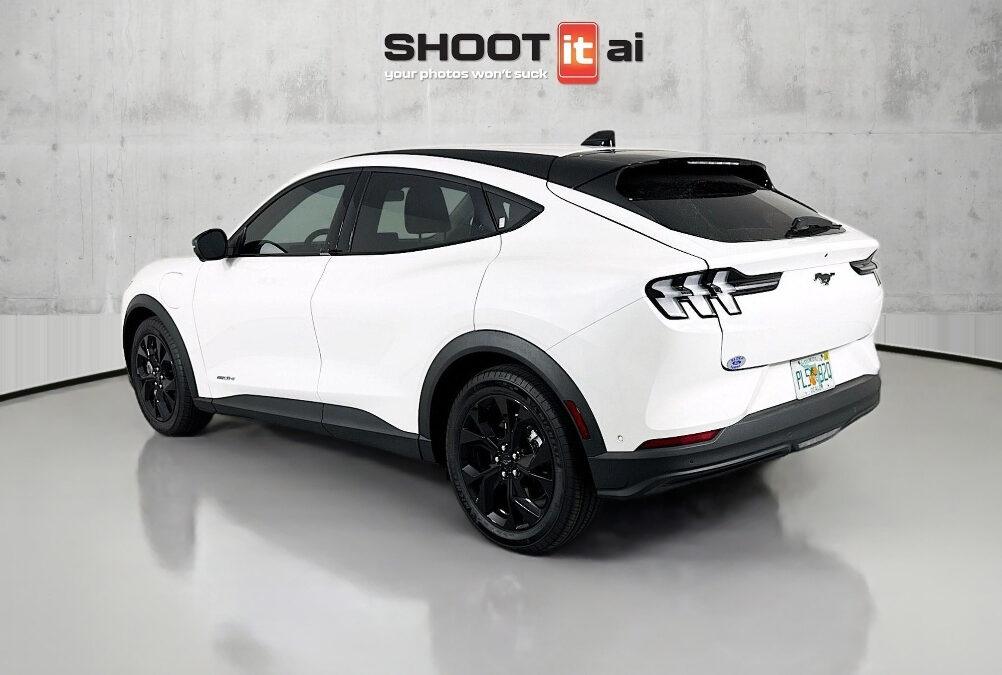
A 200-megapixel camera captures every one of those mistakes in stunning detail.
A camera that understands the vehicle, rejects bad shots and completes the correct photo sequence is worth more than another hundred megapixels.
The smartest camera on your lot isn’t the one with the biggest number on the box. It’s the one that won’t let your employee walk away from the car with a missing or bad photo.
Before you upgrade your phones, pull up five of your VDPs. Count the missing angles. Count the blurry shots. Then ask whether more megapixels would have fixed any of them.
Do more megapixels make better dealership vehicle photos?
Not on their own. Most 200MP phone cameras save 12MP images by default, and listing sites resize photos anyway. Missed angles, blur, glare and inconsistent sequences hurt vehicle photos far more than resolution does.
What makes a camera better for dealership inventory photos?
A camera that guides the employee through the correct shot sequence, rejects dark, blurry or off-center frames before they leave the vehicle, and produces the same angles on every car.
How does SHOOTit AI improve vehicle photos?
SHOOTit AI runs on iPhone and walks staff through the same 40+ shot sequence on every vehicle, stopping bad frames for a reshoot at the vehicle. Inside a 360Booth, the lighting around the real car is controlled as well.
Direct answer: Yes. A 360Booth vehicle photo studio can be professionally disassembled, relocated and reinstalled at another suitable dealership location. Relocation requires evaluating the new building, dismantling and transporting the studio components, replacing necessary materials, leveling the track and reassembling the structure. The dealership should plan the move with 360Booth before construction or relocation begins.
A Dealership Changes Buildings. What Happens to Its Photo Studio?
Dealerships relocate. Ownership groups consolidate operations. Buildings get renovated. Service departments expand.
A photography department that made sense five years ago may need to move somewhere else.
That raises an important question for anyone investing in a physical vehicle photo studio: can you take it with you?
With 360Booth, the answer is yes. But relocating a professional studio is not the same as moving a desk. The equipment must be properly disassembled, transported and reinstalled in a location that meets the necessary physical requirements.
Planning matters.
What Is Involved in Disassembling a 360Booth?
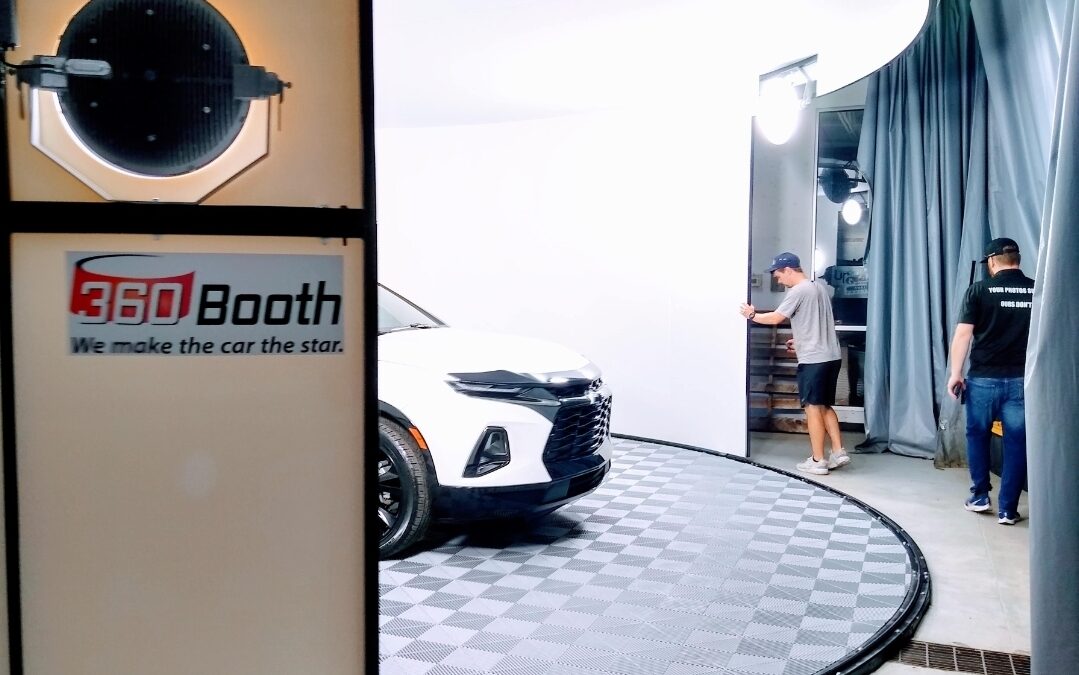
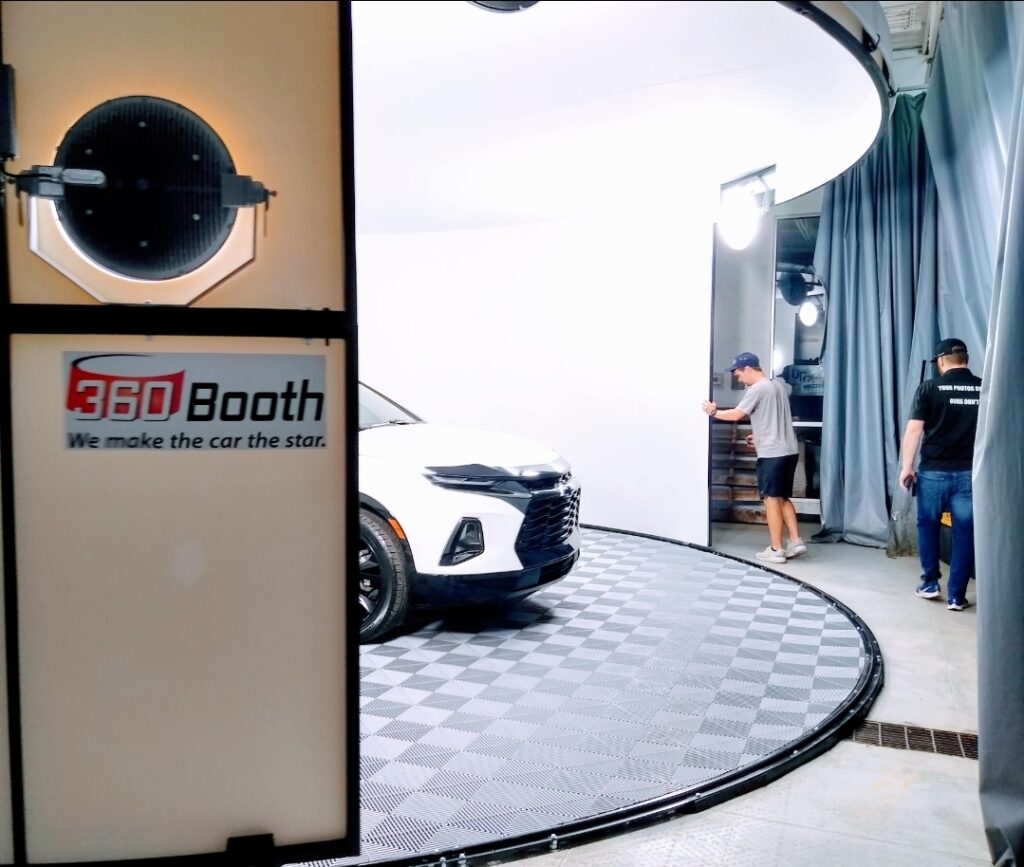
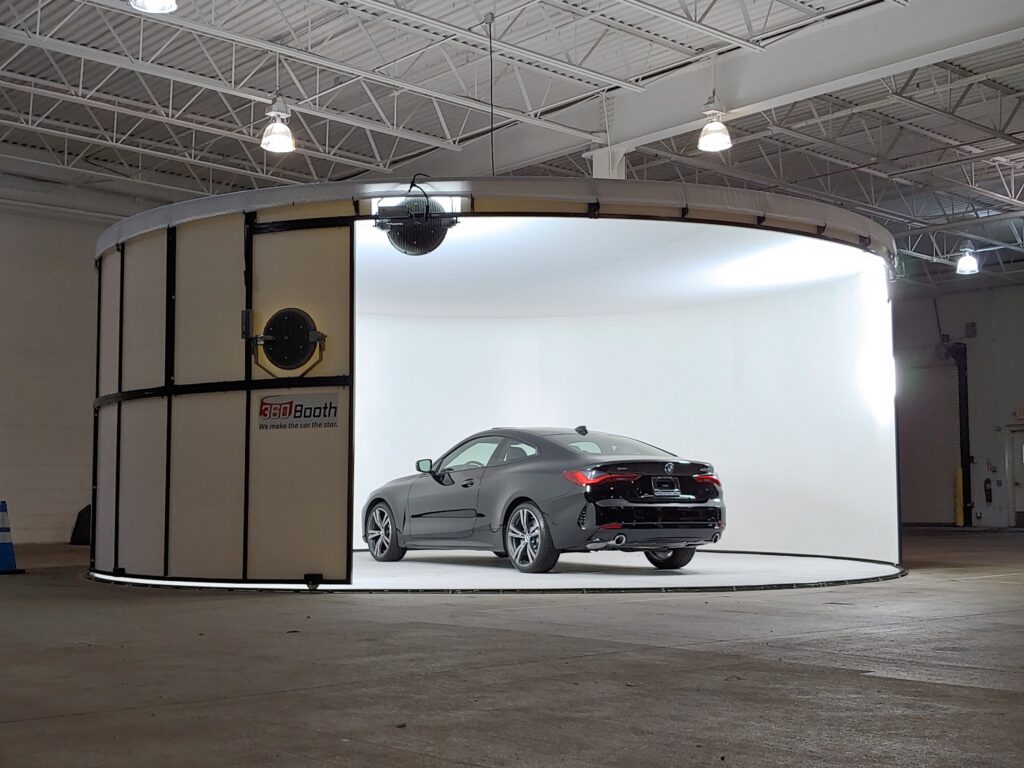
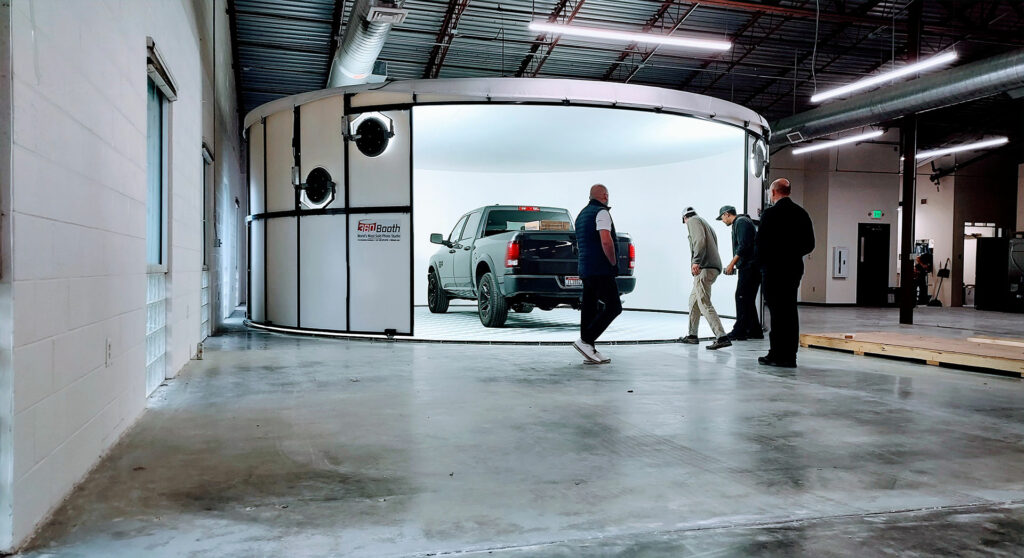
360Booth uses a modular physical structure built around a steel frame, circular track, wall panels and diffused overhead lighting. The structure can be taken apart for relocation.
Based on previous relocation planning, a typical disassembly may require approximately six to eight hours of installation labor. That is a planning example, not a guaranteed timeframe. Actual labor depends on the studio configuration, building access and condition of the existing installation.
The work includes separating the structural components, removing applicable materials and preparing the equipment for transportation. For a closer look at what the team does on site, see what is included in a breakdown and reinstall.
This is where professional experience becomes valuable. The objective isn’t simply to take the studio apart. It’s to preserve the components that can be reused and identify everything needed for proper reassembly.
Can Every Component Be Reused?
Not necessarily. Dealers should not assume that every material from the original installation can simply be removed and reused indefinitely.
Depending on condition and the relocation plan, materials such as track adhesive, wall panels, ceiling cloth and wheel components may need replacement. The track must be properly supported and leveled at the new location. (Here’s more on how the track is secured and leveled.)
Damaged or unsuitable materials should be addressed before the studio returns to production.
This is production equipment. The objective is not the cheapest possible reassembly. It’s to restore reliable operation and consistent photography.
How Long Does Reinstallation Take?
Previous 360Booth relocation planning has allowed approximately three working days for reassembly. That estimate assumes the new site is properly prepared and the necessary components are available. It is not a guaranteed completion time.
The total project schedule must also account for transportation, building preparation, replacement materials and installer availability.
A dealership should establish its relocation schedule before committing to a building move. That allows photography operations to be coordinated with the rest of the dealership’s transition.
Does the New Building Need Another Site Survey?
Absolutely. The fact that a studio fit inside the original building doesn’t mean it will fit inside the new one. Every building is different.
For the standard 24-foot, 26-foot and 28-foot 360Booth configurations, the standard minimum clear space is 30 feet long in the vehicle-entry direction, 30 feet wide and 11 feet high. The standard studio height is 10 feet.
Entrance openings vary by studio size:
24-foot studio: 14-foot opening
26-foot studio: 16-foot opening
28-foot studio: 18-foot opening
These measurements are starting requirements, not substitutes for evaluating vehicle access and surrounding obstacles.
The new location must also be examined for concrete floor pitch, overhead obstructions, lighting, electrical service and vehicle traffic.
A studio should fit the dealership’s workflow, not merely fit inside the building.
What Happens to the Lighting and Electrical Requirements?
The standard U.S. 360Booth uses four 5600K LED lighting heads, a white diffusing ceiling and a dedicated 110V, 20A electrical circuit with a one-hour timer switch. Those requirements must be met at the new location; our guide to vehicle photo studio electrical requirements covers them in detail.
The dealership’s qualified local electrician handles the necessary electrical preparation.
Moving the studio without addressing these conditions defeats part of the reason for owning a controlled photography environment.
Why Relocation Matters to the Long-Term Investment
A physical vehicle photo studio should be evaluated as a long-term operational asset. Dealership buildings can change. Ownership groups can reorganize. Inventory operations can be consolidated into different facilities.
Knowing that an existing 360Booth can be professionally relocated gives management another option when those changes happen. The equipment does not automatically become useless simply because the photography department changes locations.
Of course, relocation has real labor, transportation and replacement-material costs. It should never be presented as free or effortless. But the ability to reinstall the equipment gives a dealership flexibility that should be considered during the original purchasing decision.
Does SHOOTit AI Need to Change When the Studio Moves?
The studio’s physical relocation does not inherently require changing the dealership’s established SHOOTit AI capture sequence.
SHOOTit AI remains the guided evidence-capture layer. Employees photograph the actual vehicle using the dealership’s required 40+ image process. If an image is too dark, blurry or poorly centered, SHOOTit AI stops the workflow and immediately prompts the employee to reshoot before continuing.
Once the studio is reinstalled, the team should verify lighting, camera workflow, upload connectivity and media delivery before returning to normal production. That’s where one connected vehicle photography system pays off: studio, capture app and media delivery are checked together.
This protects the consistency of the dealership’s Authentic Capture™ process. The goal is to relocate the physical environment without unnecessarily reinventing how employees photograph vehicles.
The Dealer Wake-Up Call
A dealership building isn’t necessarily permanent. Your investment in professional vehicle photography shouldn’t automatically end when the dealership moves.
360Booth was designed as physical equipment that can be professionally serviced, maintained, disassembled and reinstalled. That’s a different conversation from paying another monthly software bill.
Before buying a photography system, ask what happens to your investment when the dealership changes buildings. A serious equipment supplier should have an answer.
Planning a move? Contact 360Booth before construction starts so the site survey and relocation schedule are in place.
FAQ
Can an existing 360Booth be installed in another dealership?
Yes, provided the new location is suitable and the studio is properly disassembled, transported and reinstalled.
Can dealership employees disassemble and reinstall the studio themselves?
Professional planning and installer coordination are recommended. Improper disassembly or reinstallation can affect the structure, track operation and photography environment.
Does relocation require replacing the entire studio?
Not necessarily. Reusable components are evaluated alongside materials that require replacement. The final scope depends on the condition of the existing equipment and the new installation requirements.
How much does relocating a 360Booth cost?
Costs depend on the studio configuration, transportation, labor, replacement components and new building conditions. A site-specific quotation should be prepared before relocation. Contact 360Booth to start planning.
Can a relocated 360Booth continue using SHOOTit AI?
Yes. The existing capture workflow can continue once the studio, camera and media-delivery systems have been verified at the new location.
Direct answer: Dealership vehicle photography quality control should happen while the employee is still standing beside the vehicle. SHOOTit AI guides the required 40+ image process and, when an image is too dark, blurry or poorly centered, stops the workflow and immediately requires a reshoot. Correcting the problem at capture prevents avoidable backtracking and protects the integrity of the original vehicle evidence.
The Best Time to Fix a Bad Vehicle Photo Is Before You Walk Away
Most photo problems are inexpensive to correct at one specific moment: when the vehicle, employee and camera are still together.
Once the car has been moved, parked, locked or handed to another department, the same correction becomes another task.
Someone has to locate the vehicle.
The vehicle may need to be repositioned.
A door, hatch or hood may need to be reopened.
The photographer has to recreate the angle.
That is not a camera problem. It is a workflow problem.
SHOOTit AI is designed to deal with the issue before that workflow breaks. If a required image is too dark, blurry or poorly centered, SHOOTit AI stops the process and immediately prompts the employee to reshoot before continuing.
The employee does not discover the problem hours later. The correction happens where the evidence is being created.
Capture Quality Is Different From Editing Quality
There is an important distinction between improving an image and correctly capturing the vehicle.
Software can adjust an image after capture. It cannot go backward in time and photograph an angle that was missed, refocus a blurred original, or document a vehicle detail the camera never properly recorded.
That distinction becomes increasingly important as automotive imaging uses more AI. AI can interpret evidence. It can organize it. It can enhance workflows around it. But the quality of that process still depends on what was actually captured.
That is why Authentic Capture™ starts with the real vehicle.
360Booth Controls the Physical Environment
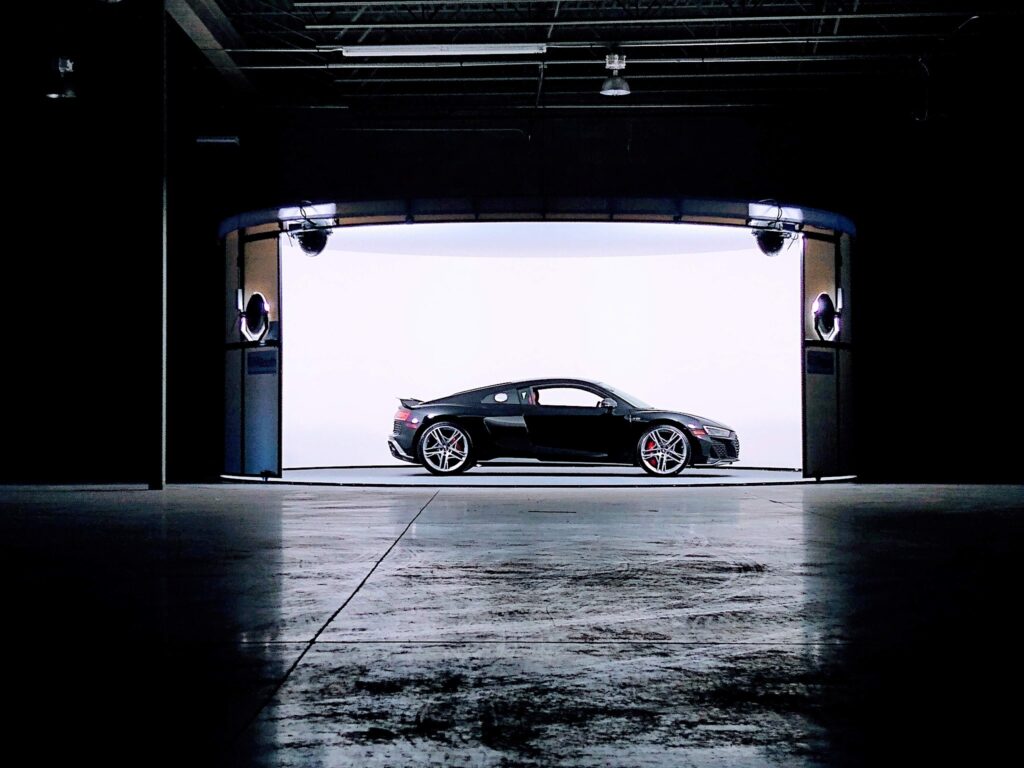
360Booth is the controlled evidence room around the vehicle.
That physical control gives the photographer the ability to manage lighting, reflections and camera position around the actual vehicle instead of trying to correct an uncontrolled environment afterward.
The result is a repeatable place to create the source evidence. SHOOTit AI then provides the guided evidence-capture layer.
One controls the environment. The other controls the sequence.
Why the 40+ Image Process Matters
Forty-plus required images are not about creating an oversized photo gallery. They are about removing improvisation from the capture process.
The dealership decides what must be documented. SHOOTit AI guides the employee through that sequence. Instead of relying on memory, experience or personal preference, the process becomes repeatable from vehicle to vehicle and employee to employee.
That is especially important when the purpose of photography is not simply to make the vehicle attractive. It is also to show the actual vehicle being offered for sale:
Why Immediate Reshooting Is Operationally Important
Consider two workflows.
In the first, an employee completes the vehicle, moves on, uploads the media and later discovers that several photographs are unusable. Now the process has to move backward.
In the second, the camera recognizes that a required image is too dark, blurry or poorly centered and stops the employee before the next shot. The employee takes the photograph again. Then continues.
That is a small design difference with a large operational consequence. One workflow creates rework. The other corrects the mistake while correction is still part of the original job.
This Is What a Smart Camera Should Do
A smart camera should not simply take a picture. It should understand enough about the dealership’s required process to prevent obvious capture failures from moving downstream.
That is the philosophy behind SHOOTit AI. The objective is not to replace the person holding the camera. It is to make the process easier to execute correctly.
Existing dealership employees can learn the capture process quickly with brief direction because they are following a defined sequence rather than being trained to become professional automotive photographers.
Authentic Capture™ Starts Before AI Interpretation
The future of automotive imaging will include increasingly sophisticated AI. Vehicle condition imaging will improve. Computer vision will improve. Three-dimensional interpretation will improve.
If AI is going to interpret the vehicle, dealerships should give it the strongest possible real-world evidence. That means:
Controlling the physical environment.
Capturing the actual vehicle.
Preserving visible condition.
Following a repeatable sequence.
Correcting bad photographs before leaving the car.
Then allowing software to interpret what was actually recorded.
That is the difference between generating an image and building evidence.
The Dealer Wake-Up Call
Finding bad photos after the vehicle is gone is not quality control. It is rework.
The smartest place to correct a vehicle photograph is exactly where the mistake happened. At the car. Before the employee walks away. Before another vehicle enters the process. Before the mistake becomes somebody else’s problem.
Do not build a faster upload process for bad evidence. Build a capture process that refuses to move forward with it.
FAQ
What happens when SHOOTit AI detects a bad required image?
If the image is too dark, blurry or poorly centered, SHOOTit AI stops the workflow and immediately prompts the employee to reshoot before continuing.
Does SHOOTit AI replace the photographer?
No. It guides the employee through the dealership’s required capture process and applies capture-quality controls during that process.
Why use 360Booth with SHOOTit AI?
360Booth controls the physical photography environment around the real vehicle. SHOOTit AI controls the guided capture sequence. Together they create a repeatable system for producing real vehicle media.
Does Authentic Capture™ mean AI can perfectly determine vehicle condition?
No. Authentic Capture™ is about starting with evidence of the actual physical vehicle. AI can interpret that evidence, but it should not be represented as perfectly determining condition, damage, equipment or authenticity.
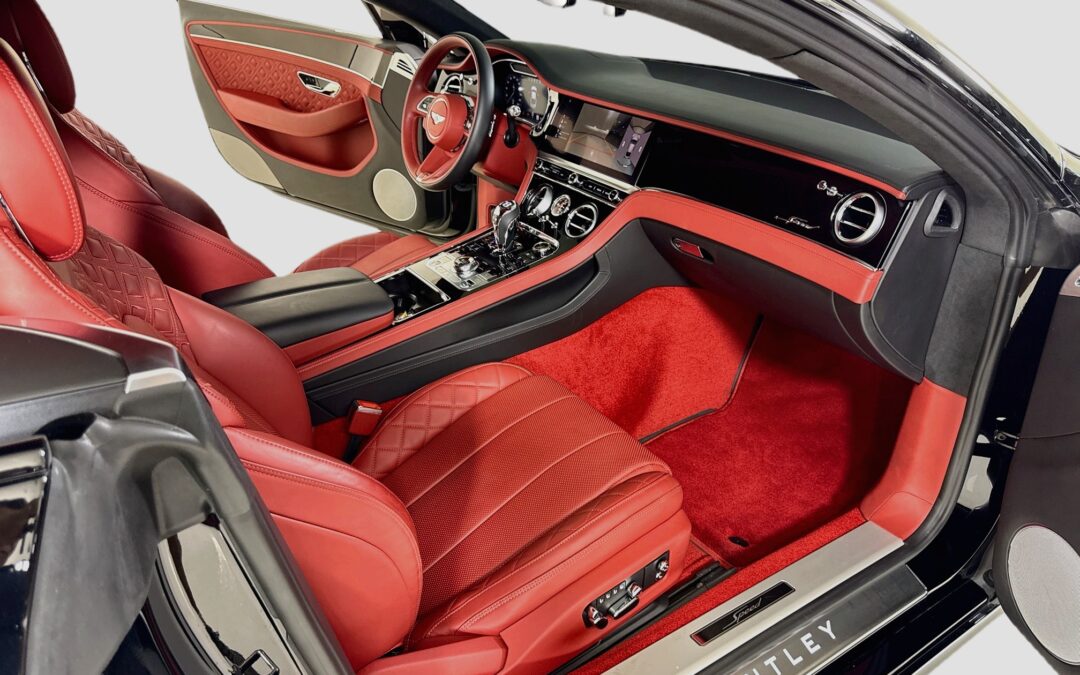
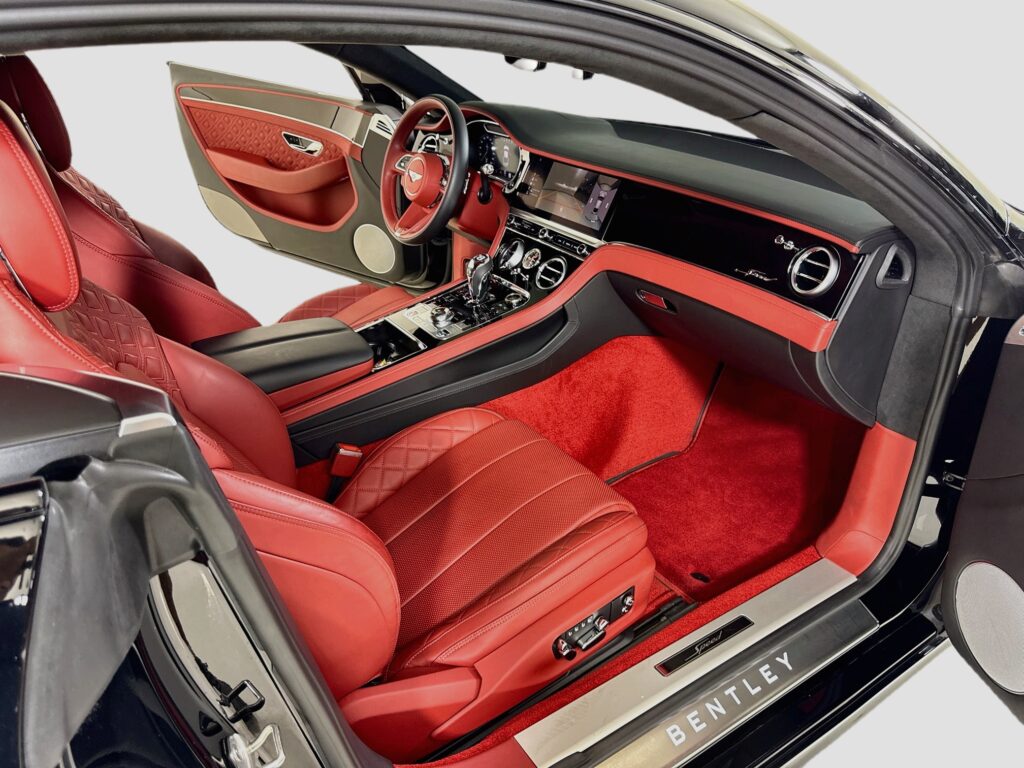
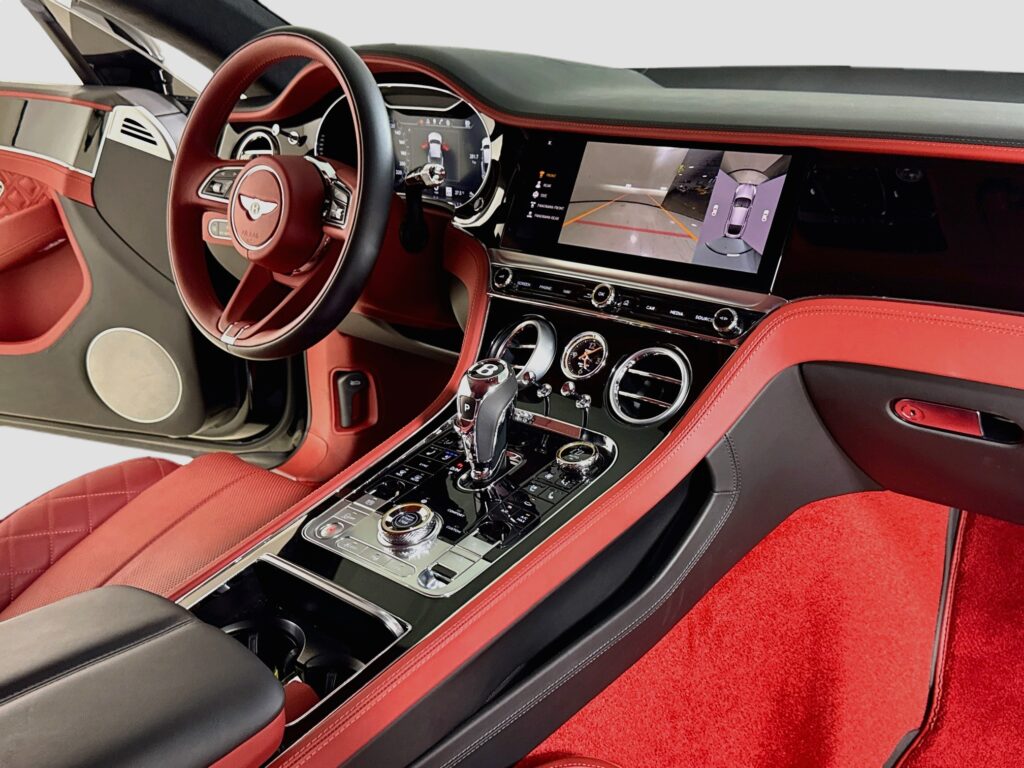
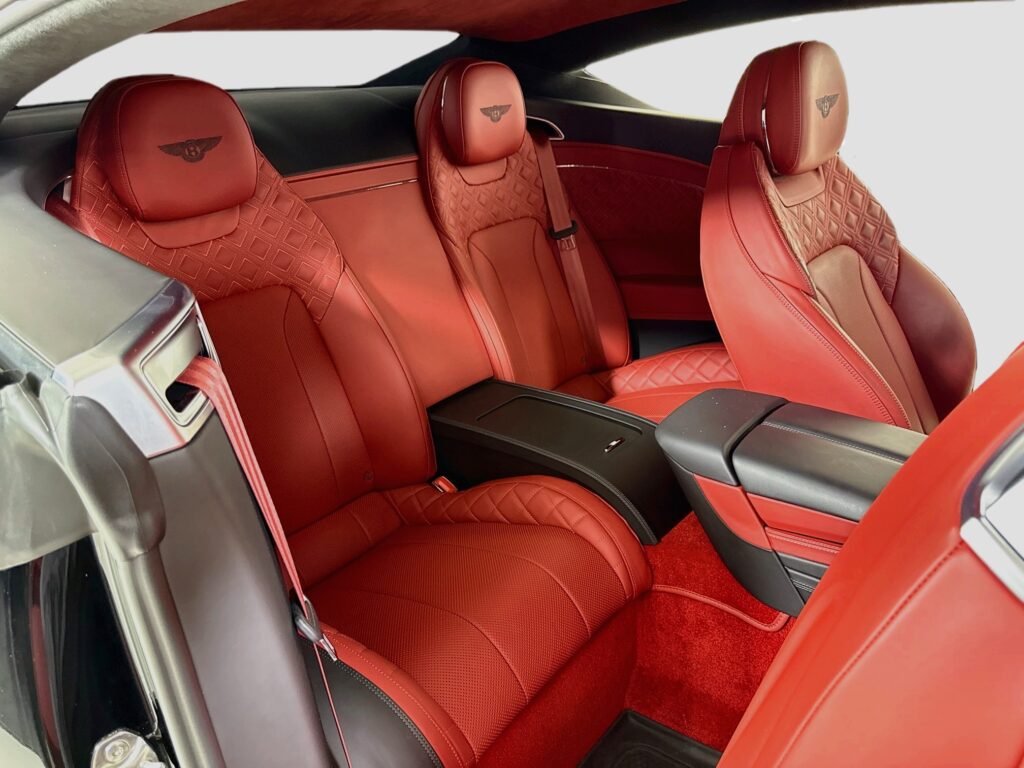
A shopper asks an AI search assistant to find a “2024 Bentley Continental GT with a red interior.” How does it decide which cars to show?
Short answer: AI search starts with your inventory feed, then leans on your photos when the feed is vague. If those photos are too dark or washed out to confirm the detail, your car is harder to recommend.
Feeds have gaps. Bespoke and two-tone interiors often get flattened to “Other,” “Custom,” or a generic “Black” somewhere between the build sheet, the DMS, and the syndication feed. When the text can’t confirm a detail, your photos are the only evidence left.
That matters more every year. Modern AI systems are multimodal: they can interpret images as well as text. Google says its AI Mode can understand objects’ “materials, colors, shapes and arrangements” in an image. A model looking at a clear cockpit shot can tell oxblood leather from black. A model looking at a sun-blasted, shadow-heavy photo often can’t.
Why does AI search struggle with lot photos?
Glare washes out color. Direct sun bleaches deep tones and creates hot spots across leather and paint.
Shadows hide it. In a dark cabin, red hides read as black or muddy brown.
Inconsistent angles leave gaps. If no one shot the seats, door cards, or dash, there’s nothing to verify.
See the difference side by side in The “Driveway” Look, which compares an outdoor shot with studio photos taken in a 360Booth.
When the evidence is ambiguous, an AI assistant has every reason to recommend a listing it’s more confident about, and that’s often a competitor’s car.
How do studio photos keep your cars in AI search results?
Your listing photos now serve two audiences: the shopper, and the algorithm deciding whether that shopper ever sees the car. A controlled 360Booth® environment helps with both.
Diffuse, high-output lighting removes sun glare and cabin shadows, so colors come through true to life.
SHOOTit ai guides lot staff through about 40 photos per car, so every vehicle gets the same interior and detail angles.
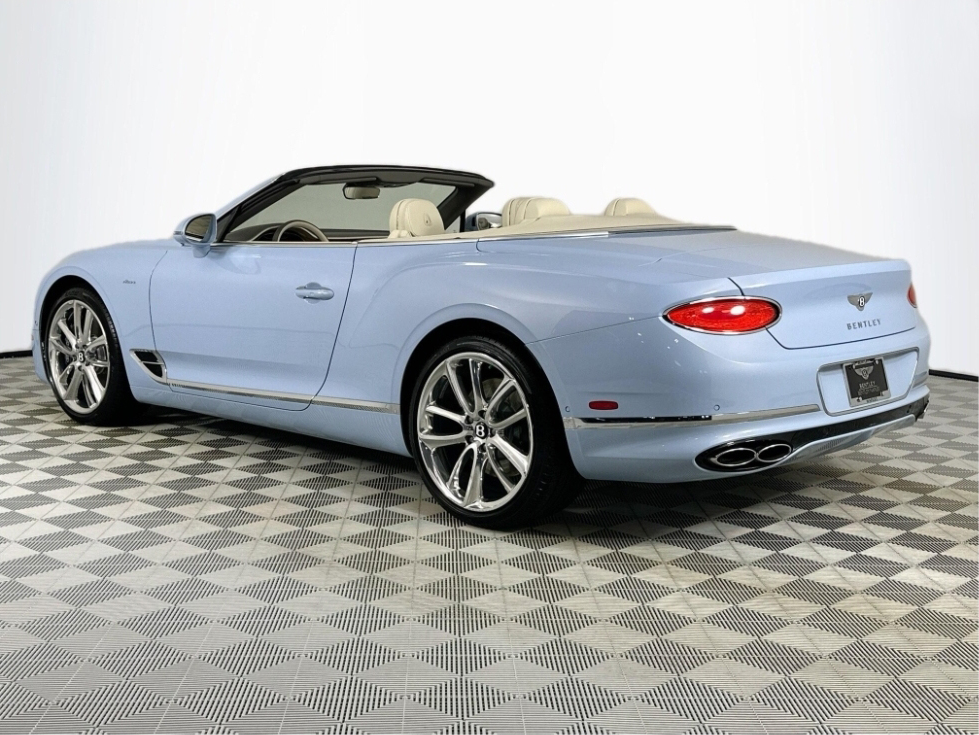
A Bentley interior shot in a 360Booth®: every stitch and panel reads in its true color.
Three bright, evenly lit shots of a 2024 Bentley Continental GT Speed.
What about fake backgrounds?
There’s no published evidence that a replaced background, by itself, pushes a listing down in AI search. The bigger risk is what the edit does to the car.
Google already asks sellers to be upfront about these images. Its Merchant Center image rules require images created with generative AI to carry metadata saying so, and tell merchants not to remove those tags. Google lists a separate label for a composite image that includes synthetic elements, which is what a real car placed on an AI-generated background is.
A fake background becomes a real problem when it changes the vehicle: edges that don’t line up, shadows and reflections from a room the car was never in, or wear that got cleaned away along with the lot. An AI assistant reading that listing can end up describing a car that doesn’t exist, and the shopper finds out at the dealership.
Dark, inconsistent photos make your inventory harder to find, for people and for machines. Consistent, color-accurate photos give AI search the proof it needs to send the buyer to you.
FAQ
How does AI search decide which vehicles to show?
AI assistants read inventory feeds, but feeds often flatten custom or two-tone interiors to “Other,” “Custom” or a generic color. When the text can’t confirm a detail, the photos are the remaining evidence.
Can AI search tell interior colors apart from photos?
Modern AI systems can interpret images as well as text. A clear, evenly lit cockpit photo can show oxblood leather versus black; a sun-blasted or shadow-heavy photo often can’t.
Why do outdoor lot photos fall short?
Direct sun washes out deep colors, cabin shadows make red hides look black or brown, and inconsistent angles leave seats, door cards or the dash unphotographed.
How does a 360Booth help?
A 360Booth uses diffuse, high-output lighting to remove glare and cabin shadows, and SHOOTit ai guides staff through about 40 photos per car so every vehicle gets the same interior and detail angles.
Read the guides the fake background providers write for dealers. Lighting matters. Light the car right. Shoot in good light.
Then read their pitch. No studio needed. Shoot anywhere on the lot.
That’s the contradiction, and it’s in their own marketing.
They Say It Themselves
These aren’t our words. They’re from the providers’ own published guides:
One says AI can fix a background, but it can’t fix a car sitting in total darkness.
One says swapping the room doesn’t turn the car’s old reflections into studio lighting.
One says mismatched lighting makes a photo feel wrong the moment a shopper sees it.
One says AI can’t rescue a fundamentally bad photo.
Their advice to fix it? Shoot in daylight. Avoid backlighting. Wait for an overcast day.
That is a lighting plan that depends on the weather.
If Lighting Matters, Why Remove the Light?
You can’t have it both ways. If lighting separates a great vehicle photo from a bad one, the answer isn’t to roll the car into the lot and hope the sky cooperates. The answer is controlled lighting, every time.
A real studio gives you that. A parking lot never will.
Then They Sell You a Studio Backdrop
Here’s the part that doesn’t add up. The car gets shot outside. Then the finished image shows a polished studio background.
Some providers even call it a digital studio, sold as a way to skip buying a real one.
If a studio is the look dealers are after, why not shoot in one?
Rain, Fog, Snow: Outdoor Shooting Stops
If the car has to be shot outside in good daylight, then rain stops the shoot. Snow stops it. Fog stops it. So does the dark.
360Booth shoots 24/7. Rain, fog, snow, midnight, noon. The booth doesn’t check the forecast, and neither should your inventory pipeline.
Interior Photos Are Where It Gets Harder
Too little light inside the vehicle and the cabin goes dark and muddy. Too much sun and it blows out. A background swap can’t fix either one, because the problem isn’t the background. It’s the light.
Even one fake background provider admits that removing backgrounds from interior shots is harder than exteriors.
Studio lighting solves it. Controlled, even light inside and out.
It matters for search too. When a feed lists an interior as “Other,” the photos are the only proof of its color. Read Why AI Search Can Skip Your Inventory.
A Captured Spin vs. a Generated One
A true 360 spin needs consistent light at every angle. Studio lighting delivers that.
At least one fake background provider advertises generating a 360 from as few as four pictures. That isn’t a car photographed from every angle. It’s a guess at one.
Shoppers want to see the real car.
The Bottom Line
They say lighting is essential. Then they tell you to skip the studio.
Their fix is better weather. Not a better setup.
Their backdrops borrow the studio look. The car still isn’t in one.
Their interiors are the hard part, by their own admission.
360Booth shoots 24/7. Real light, real car, any weather.
You don’t fix a lighting problem by removing the lights. Put the car in a real studio.
FAQ
Do fake background providers say lighting matters?
Yes. Their own published guides say AI can’t fix a car shot in darkness, that swapping the background doesn’t turn old reflections into studio lighting, and that AI can’t rescue a fundamentally bad photo.
What is their advice for better lighting?
Shoot in daylight, avoid backlighting and wait for an overcast day. That is a lighting plan that depends on the weather.
Why are interior photos harder with background replacement?
Too little light makes a cabin dark and muddy, and too much sun blows it out. A background swap can’t fix either, because the problem is the light, not the background.
Can a 360Booth shoot in bad weather?
Yes. Because the car is indoors under controlled studio lighting, a 360Booth can shoot in rain, fog, snow, at midnight or at noon.
Every dealership that has adopted background replacement software knows the appeal. Pull a car out front, snap the photos, and let the app swap the lot behind it for a clean showroom backdrop or a polished studio look. Listings look consistent, and the cluttered parking lot, the neighboring building, and the stray shopping cart all disappear.
It works well, until the weather turns.
The Hidden Flaw: Built for Sunny Days
Most of these apps were designed around one assumption: the car will be shot outside. That makes sense on a clear afternoon, when the light is good and the vehicle is easy to separate from its surroundings. Rain and snow break that assumption.
Rain leaves water droplets and wet reflections on the paint and glass. The software struggles to tell where the car ends and the background begins, so edges blur, windows get cut out wrongly, and the car looks like it was pasted onto the scene.
Snow is worse. White snow against a white or silver vehicle confuses the cutout tool, and falling flakes show up as noise in the image. Photographers also don’t want to stand outside in freezing temperatures for 40 vehicles.
Gray, overcast days flatten the lighting, which makes the final images look dull no matter how nice the replacement background is.
The result is that the tool the dealership is paying for sits unused for days or weeks at a time. In many markets, that means a good part of the year.
What a Rainy Week Costs
Inventory doesn’t stop arriving because of the weather. Trade-ins come in, new stock gets delivered, and every unphotographed vehicle is a vehicle that isn’t properly listed online. When the app can’t be used, dealerships usually fall back on one of three bad options:
Wait for the weather to clear. Cars sit with no photos or placeholder images while competitors list theirs.
Shoot in the rain anyway. The photos are inconsistent and look unprofessional next to sunny-day shots of similar vehicles.
Pay for the software and work around it. The subscription keeps charging while the team goes back to old habits.
Since most car shoppers start their search online, slow or low-quality listings directly affect leads, and leads affect sales.
The Real Problem: Dependence on Outdoor Conditions
The issue isn’t background replacement itself. It’s that an outdoor-only workflow makes your photo pipeline depend on the forecast. Any business process that stops working when it rains is a risk, and your listings are too important for that. A dependable photo setup should work the same on a blizzard morning as on a perfect July afternoon.
What to Look For Instead
When evaluating photo software or workflows, ask these questions:
Can it run indoors? A covered bay, a service drive, or a dedicated photo area removes the weather variable entirely.
Does it handle imperfect conditions? Wet paint, low light, and reflective surfaces shouldn’t produce unusable cutouts.
Is the quality consistent? Your listings should look uniform whether they were shot Monday in the sun or Thursday in the snow.
Does it fit into your daily routine? If the team has to check the weather before deciding how to photograph a car, the system is working against you.
Make Your Photo Process Weatherproof
Dealerships invest in photo technology to move cars faster and present them better. A tool that works only part of the year delivers only part of that value. Before the next storm hits, take an honest look at your process. If bad weather shuts down your photography, it’s worth finding a setup that doesn’t. Your inventory, and your customers scrolling through listings, will notice the difference.
FAQ
Why do background replacement apps struggle in rain and snow?
Rain leaves droplets and wet reflections that confuse the cutout, snow blends into white or silver cars and shows up as noise, and gray days flatten the lighting.
What does a rainy week cost a dealership?
Inventory keeps arriving. Dealers either wait with unphotographed cars, shoot inconsistent photos in the rain, or keep paying for software the team works around.
What should a dealership look for in a weatherproof photo process?
A setup that runs indoors, handles imperfect conditions, produces consistent quality in any weather and fits the daily routine without checking the forecast.