“The time and effort you put into inspecting the booth, evaluating the workspace, and following up with a detailed report was way above and beyond what anyone could have expected.”
— 360Booth customer, October 2025
“It has significantly enhanced the quality of our photo inventory and website, and it has trained our eyes to better recognize angles and focus points for each shot.”
— SHOOTit AI customer, May 2025
“Of all the vendors I deal with you guys are always on the ball to get things corrected, I appreciate it.”
— Auto Exact customer, May 2025
“I can’t tell you how much we appreciate you going out of your way to be here in person to help us.”
— 360Booth customer, December 2024
“The booth looks great and the app works really well.”
— 360Booth and SHOOTit AI customer, March 2025
360Booth Vehicle Photo Studio Reviews
Installation and on-site service
“Thank you for your prompt help getting the booth reinstalled.”
— 360Booth customer, September 2026
“Thank you to all for the assistance in getting the booth fixed.”
— 360Booth customer, July 2026
“Thank you so much for coming out, greatly appreciated.”
— 360Booth customer, January 2026
“We put the booth back on track and is functioning perfect again.”
— 360Booth customer, March 2025
“Helpful with answers when asked questions and a pleasure to have on-site doing the install.”
— 360Booth customer, November 2024
Photo quality and daily use
“You guys are awesome, thank you!”
— 360Booth customer, July 2025
“You guys are the best.”
— 360Booth customer, May 2025
“We love using our 360booth.”
— 360Booth customer, May 2025
“FYI our pics look great, I know our group is super interested.”
— 360Booth customer, December 2024
“Booth is awesome by the way.”
— 360Booth customer, November 2024
Fast answers and follow-up
“Thanks again for your excellent customer service.”
— 360Booth customer, October 2026
“Thanks for all your help answering my questions.”
— 360Booth customer, June 2026
“Thank you so much for the quick response to my email!”
— 360Booth customer, May 2026
“Thank you so much for your quick response.”
— 360Booth customer, July 2025
“Thanks … for the great service.”
— 360Booth customer, July 2025
“Thank you for the quick response and follow up with this project.”
— 360Booth customer, April 2025
SHOOTit AI Smart Camera Reviews
Better photos on the website
“Excellent and very helpful to the SUV shopper.”
— SHOOTit AI customer, December 2025
“Everything looks great! Thanks for your help!”
— SHOOTit AI customer, March 2026
“That sounds perfect, thank you for your help in this matter.”
— SHOOTit AI customer, January 2026
“Looks great. Thanks for all the help. I appreciate it.”
— SHOOTit AI customer, January 2026
Quick fixes and uploads
“Awesome, we got it back up. Thank you so much!”
— SHOOTit AI customer, August 2026
“Really appreciate the quick assist on this matter.”
— SHOOTit AI customer, June 2026
“Refreshed again and all working now.”
— SHOOTit AI customer, February 2026
“All 14 have uploaded successfully. Thank you for the quick response!”
— SHOOTit AI customer, February 2026
“Everything working perfect now.”
— SHOOTit AI customer, October 2025
“Thank you, it’s working great now!”
— SHOOTit AI customer, September 2025
Auto Exact Data Team Reviews
Websites, banners and reprocessing
“Looks perfect on our website. Thanks again!”
— Auto Exact customer, November 2025
“All looks good! Thank you for your help!”
— Auto Exact customer, October 2025
“Fantastic! Thank you so much. You guys are too good.”
— Auto Exact customer, September 2025
“Thank you for reprocessing both vehicles, I appreciate your help.”
— Auto Exact customer, August 2025
“The banners look great, thanks again!”
— Auto Exact customer, March 2025
Responsive, patient support
“Many thanks for your help and checking back in.”
— Auto Exact customer, July 2026
“Thank you so much for the quick turnaround on this.”
— Auto Exact customer, May 2026
“Really appreciate you helping us find a workaround!”
— Auto Exact customer, April 2026
“Thanks for the great follow ups. You guys are amazing.”
— Auto Exact customer, December 2025
“Thank you so much again for your patience, I really appreciate you for helping me all the time.”
— Auto Exact customer, November 2025
“I just wanted to express my gratitude for all your assistance. It has been wonderful working with you.”
— Auto Exact customer, May 2025
“You guys are the best.”
— Auto Exact customer, April 2025
“Thank you for your quick response—as usual!”
— Auto Exact customer, April 2025
“Great, thanks so much for the quick help!”
— Auto Exact customer, February 2025
“I am so grateful for your speedy support! Absolute legend!”
— Auto Exact customer, January 2025
“Thank you for the fast response and I will take a look and get back to you if anything else needs to be done.”
— Auto Exact customer, November 2024
“Thank you for the quick response.”
— Auto Exact customer, October 2024
Customer Support Across the System
“Working as should now, thank you for all of your help sir. It’s greatly appreciated.”
— Customer support, March 2025
“Just tested it and is back working fine again. Thanks a lot, I appreciate your help.”
— Customer support, November 2024
Want to see what dealers are talking about? Visit our Customer Reviews page or reach out below.
Listen to what Alex Shikhmuradov had to say about his experience with 360Booth®: “At Porsche Redwood City, we believe that every luxury car deserves to be showcased in its best light. That’s why we’ve invested in 360Booth® , a game-changer for photographing our inventory. In just 5-7 minutes, we can take professional-grade photos including stunning…
Direct Answer: A dealership group can standardize vehicle photography across multiple locations without requiring identical buildings or equipment. Establish one required photo sequence, use VIN-based capture guidance, enforce image-quality standards and verify correct media delivery. Install 360Booth where space permits, establish controlled DIY photography areas where appropriate and use SHOOTit AI for guided outdoor capture when necessary. The photography environment can vary. The evidence standard should remain consistent.
The Biggest Multi-Store Photography Problem Isn’t the Camera
Imagine owning ten dealerships.
Three photograph vehicles inside dedicated studios. Four use service or detail bays. Three photograph everything outdoors.
Each location has its own photographer, equipment preferences and approach to vehicle merchandising.
One store publishes 45 photographs. Another publishes 18. Another has beautiful exterior photographs but almost nothing showing the interior.
Management sees ten dealerships selling vehicles under the same ownership group. Customers see ten different standards of professionalism.
The problem isn’t necessarily the equipment. The problem is that nobody established one photography standard for the entire organization, and that problem doesn’t disappear simply because every dealership purchases the same camera. It’s the same reason dealership vehicle photography is still inconsistent at so many single stores, multiplied across every rooftop.
Standardize the Photographs Before Standardizing the Buildings
The first decision for a dealership group should be determining what every completed vehicle photo set needs to communicate. We’ve argued before that dealer group vehicle photography should be governed as one brand standard. This article is about how to put that standard into practice when your buildings don’t match.
Customers want to see the actual vehicle. That includes its exterior appearance, interior, equipment, wheels, cargo areas and visible condition.
A repeatable core image sequence creates consistency. SHOOTit AI guides employees through the dealership’s required 40+ image process. The employee follows an established sequence rather than deciding which pictures to take at every vehicle.
Additional images can be captured when the vehicle has equipment or condition details that deserve closer examination.
That distinction matters. A consistent process does not mean photographing every vehicle as though it has identical equipment. It means giving every vehicle the same level of attention. For more on why a defined sequence beats individual judgment, see What Makes Dealership Vehicle Photography Fast, Simple and Repeatable?
VIN Identification Should Come Before Photography
SHOOTit AI begins by capturing the vehicle VIN. The system uses VIN-decoder information to identify equipment and standard features expected on that particular vehicle. This makes the photography process vehicle-aware.
Consider an employee who reaches a requested equipment photograph but cannot immediately locate the feature. The employee attempts to skip the photograph. If the decoded vehicle information identifies that equipment as a standard feature, SHOOTit AI immediately warns the employee to check again.
That is important when a dealership group employs people with different levels of automotive experience. Employees shouldn’t need to memorize the equipment specifications of every manufacturer. The camera provides guidance based on the vehicle information.
The VIN identifies what should be there. The employee documents what is actually there.
VIN decoding is not infallible. Equipment can vary, and a human must resolve discrepancies between expected features and the physical vehicle. The system should guide the inspection, not invent equipment or declare a vehicle’s configuration perfectly verified.
The Building Determines the Environment, Not the Photography Standard
This is where dealership groups frequently make unnecessary compromises. They assume that if every location cannot accommodate an identical studio, the group cannot establish a consistent photography process.
That’s incorrect. There are three practical approaches.
1. Install 360Booth Where Space Permits
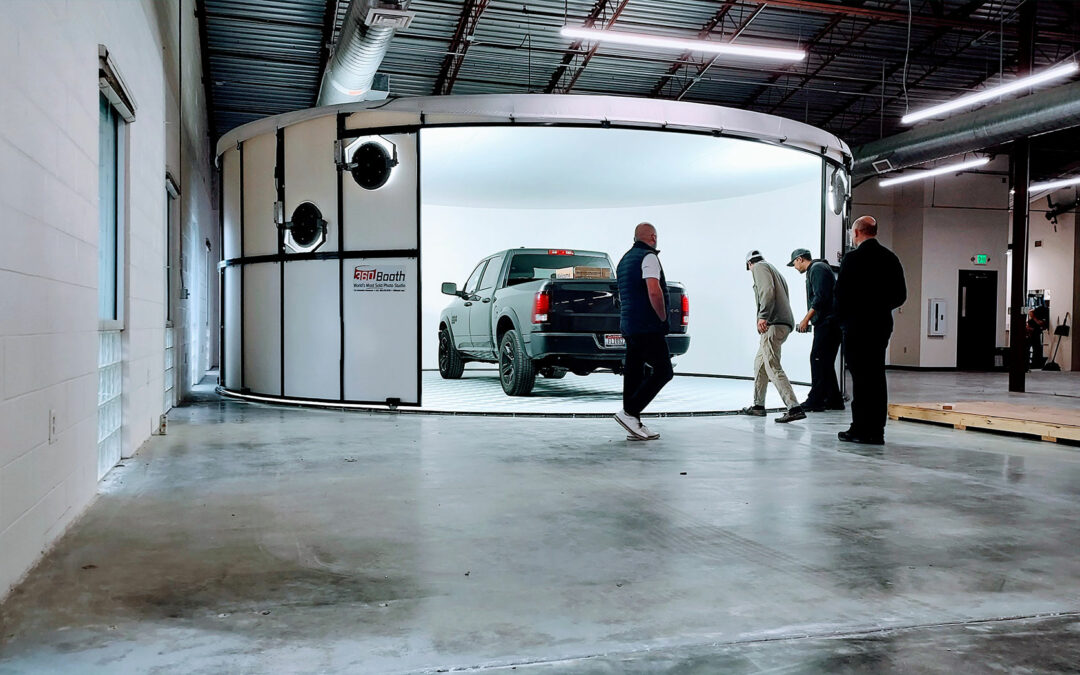
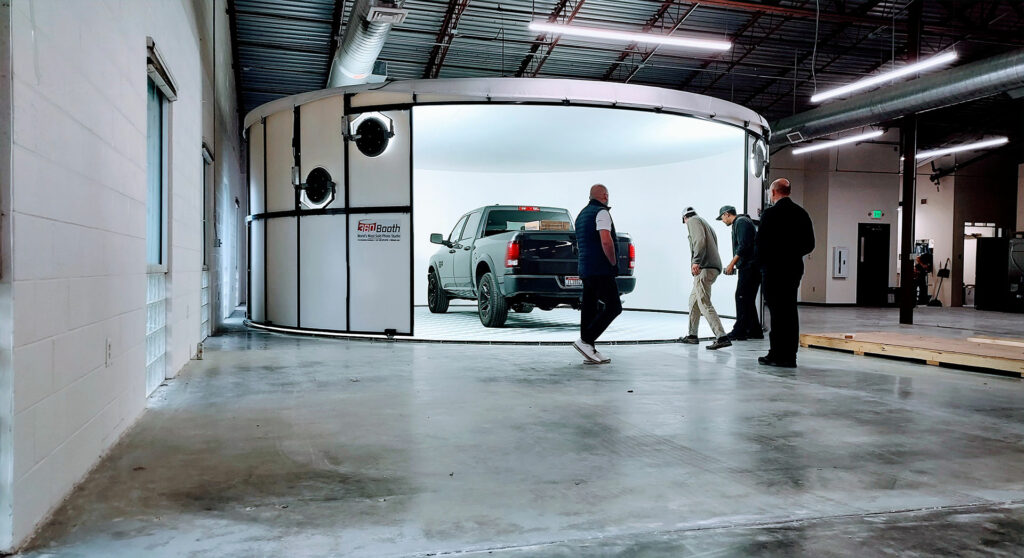
360Booth provides the controlled physical photography environment. The vehicle remains stationary while the studio structure moves manually around it. There is no motorized vehicle turntable.
The studio uses its own lighting system and diffused white ceiling to control illumination and reflections around the actual vehicle. The result is a repeatable photography environment that isn’t dependent on outdoor lighting conditions.
For standard 24-, 26- and 28-foot studios, the minimum clear room is 30 feet long in the vehicle-entry direction, 30 feet wide and 11 feet high. A professional site survey determines whether the space, vehicle flow and building conditions are appropriate. See How much room do I need to install 360Booth® at my dealership?
2. Create a Controlled DIY Photography Area
Not every dealership has room for a complete 360Booth installation. An existing indoor area may still be suitable for vehicle photography.
Lighting, color temperature, reflections, background distractions and vehicle positioning must be evaluated.
That’s where access to more than 50 years of combined vehicle-photography expertise becomes valuable. Our experience covers dedicated studios, cameras, iPhones, lighting arrangements, DIY spaces, capture sequencing and dealership workflows.
The objective is to create the best practical physical environment available within that building.
A DIY area should not be represented as automatically matching the consistency of a purpose-built 360Booth. Its limitations need to be understood and managed.
3. Use SHOOTit AI When Indoor Photography Isn’t Practical
Some dealerships simply don’t have the appropriate indoor space. That shouldn’t prevent them from using a structured vehicle photography process.
SHOOTit AI can guide employees through the required image sequence outdoors. The camera’s intelligent guidance remains valuable even when the surrounding environment is less controlled.
However, outdoor capture remains subject to weather, sunlight, reflections and other physical limitations. Software does not make those conditions disappear.
The objective is to maintain a consistent capture process while recognizing the differences between environments.
Image Quality Must Be Enforced at Every Location
A standardized photo sequence means little if one dealership accepts dark photographs and another refuses them.
SHOOTit AI applies image-quality controls during capture. When an image is too dark, blurry or poorly centered, SHOOTit AI stops the workflow and immediately prompts the employee to reshoot before continuing.
That matters across an ownership group. Employees may have different experience levels. Photography environments may differ. But the same unacceptable image conditions should trigger the same immediate correction.
The employee doesn’t need to finish the vehicle, upload the photographs and wait for someone at another location to discover the mistake. The problem gets corrected while the vehicle is still in front of the camera. That’s why quality control should happen at the vehicle.
That is how technology reduces dependence on individual photography skills.
Management Must Separate Capture From Publication
A dealership group should also distinguish between three different events:
The vehicle was photographed.
The photographs were successfully uploaded.
The photographs appeared on the correct online vehicle listing.
Those events are connected, but they are not identical.
SHOOTit AI supports the capture and upload process. Auto Exact Data Team supports VIN-level media management, inventory feeds and delivery troubleshooting across connected systems, as part of one connected vehicle photography system.
This becomes especially important when dealerships use different inventory management platforms or website providers. A groupwide photography standard should include verifying that the correct images ultimately appear on the correct vehicle detail page.
Otherwise, management may believe a vehicle has been successfully merchandised simply because its photographs were captured.
The customer cannot shop photographs that never reach the listing.
What Should Dealership Group Management Measure?
A dealership group should be able to evaluate its photography operation without relying entirely on individual store managers’ opinions. Useful operational measurements include:
Vehicles awaiting photography
Time between photo readiness and completed capture
Required-image completeness
Upload exceptions
Vehicles missing published media
Management should also investigate unusual gaps in camera usage. SHOOTit AI’s five-day inactive-license reporting can help identify accounts that deserve follow-up.
That inactivity does not automatically prove a dealership has stopped photographing vehicles. Employees may be absent, responsibilities may have changed or devices may have been reassigned. But it provides a practical question for management to investigate.
Not every measurement needs to come from one software dashboard. Some require inventory, staffing and website-delivery information from connected systems.
The objective is operational visibility, not another report nobody reads.
Why Authentic Capture™ Matters Across Multiple Dealerships
360Booth Authentic Capture™ starts with evidence of the actual vehicle. That principle should remain consistent whether the vehicle is photographed inside a 360Booth, in a prepared indoor area or outdoors using SHOOTit AI.
The actual equipment matters. Visible wear matters. Vehicle identity matters. Accurate image assignment matters.
A dealership group should never establish consistency by digitally making every vehicle appear newer, cleaner or better equipped than it actually is. AI can organize or interpret vehicle evidence. It should not replace that evidence with imagined condition or equipment.
This is why the relationship between 360Booth and SHOOTit AI is so important. 360Booth is the controlled evidence room. SHOOTit AI is the guided evidence-capture layer. Together, they establish a practical foundation for repeatable vehicle merchandising. Where a studio isn’t feasible, the intelligent capture process remains available.
How Should a Dealer Group Begin?
Start with the photography standard, not the equipment order.
Define the standard. Determine which views every vehicle requires, which additional equipment and condition images matter, and what constitutes an acceptable finished image set.
Evaluate each rooftop. Identify the locations that support a 360Booth, those suitable for a DIY indoor area and those that must initially rely on outdoor capture. Our guide to what dealers should really look for in a vehicle photo studio covers the studio decision.
Train on one sequence. Train employees on the same guided sequence.
Verify delivery. Confirm that the completed photographs are reaching the correct inventory listings.
The goal isn’t to make every dealership building identical. The goal is to make the photography operation understandable, repeatable and accountable regardless of the building.
The Dealer Wake-Up Call
A dealership group doesn’t need ten identical buildings to operate one photography standard.
It needs one expectation. One repeatable process. Employees who understand that process. And management willing to verify the results.
We’ve spent decades developing vehicle photography systems for dealerships, auctions and large automotive operations. The lesson is straightforward.
Standardize what the customer deserves to see. Adapt the equipment to the building. Never lower the evidence standard simply because one dealership has less space than another.
That’s how vehicle photography becomes a managed operation instead of ten separate experiments.
FAQ
Does every dealership in a group need a 360Booth?
No. A 360Booth provides a controlled studio environment where the building supports installation. SHOOTit AI can also operate in appropriate DIY indoor or outdoor photography environments.
Can different dealerships follow the same SHOOTit AI photography process?
Yes. SHOOTit AI guides the dealership’s required image sequence, allowing locations to follow a consistent capture approach even when their physical photography environments differ.
Does SHOOTit AI use VIN information to guide equipment photography?
Yes. The process begins with VIN capture and uses VIN-decoder information to identify expected equipment. If an employee skips a requested standard-feature image, SHOOTit AI immediately warns them to check again.
Can AI guarantee that every vehicle's equipment and condition have been accurately documented?
No. VIN-decoder information and AI guidance support the process, but physical verification remains necessary. AI should not be represented as perfectly identifying equipment, damage, authenticity or condition.
How can management determine whether a dealership is using its camera?
SHOOTit AI’s inactive-license reporting provides visibility into accounts without recent activity. Management should investigate the reason rather than automatically assuming an employee or location has stopped working.
Should vehicle photos be checked after uploading?
Yes. Correct capture and successful upload do not guarantee correct website publication. Dealerships should verify that the proper media appears on the correct vehicle listing.
Virtual background software companies sell dealerships a slick promise: snap a picture on your smartphone, and the AI drops your car into a digital showroom.
What they leave off the marketing deck is simple. The software doesn’t take the photo. Someone still has to wash the car, roll it outside and shoot it in whatever the sky is doing that day. Across most of the country, for weeks or months every winter, the sky says no.
Meanwhile the monthly subscription bills whether you shoot 200 cars or zero.
Using regional weather data, we sorted the country into three winter tiers based on how many outdoor shooting days dealers can expect to lose.
Tier 1: The 60+ Day Blackout Zone
NY, WA, OR, OH, MI, PA
Still sending porters into 20-degree slush to photograph $60,000 inventory?
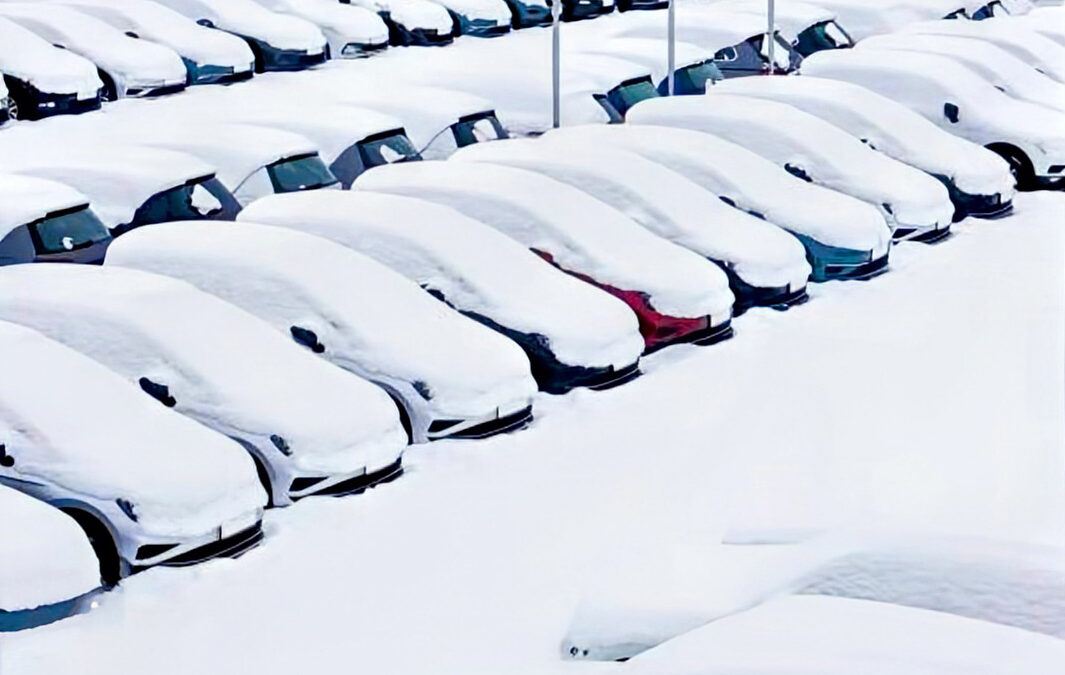
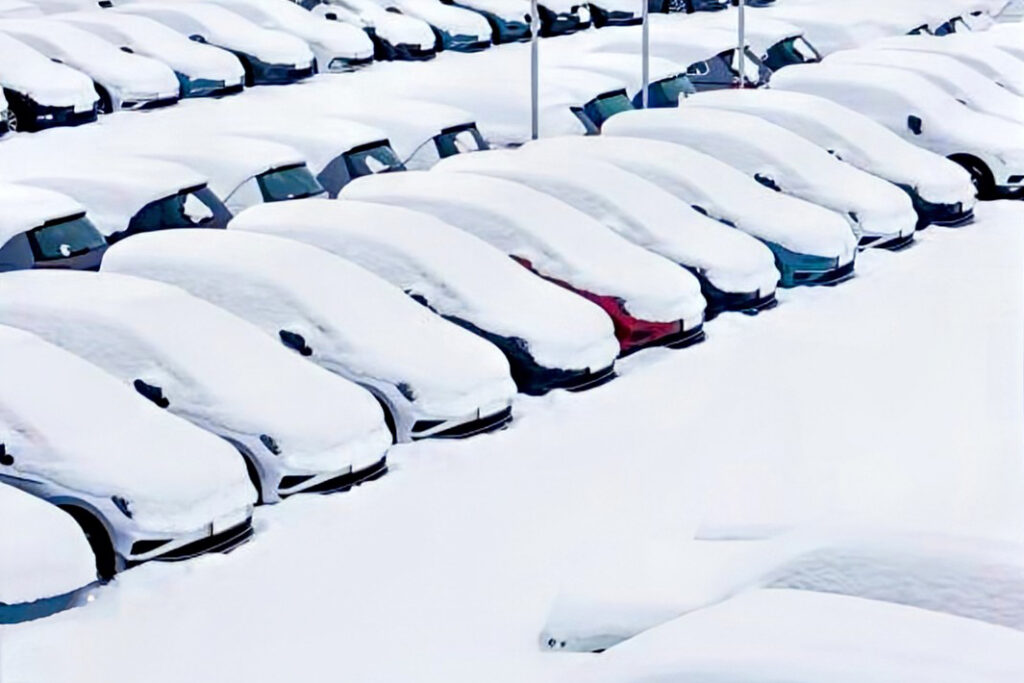
In Buffalo, NOAA’s 1991–2020 normals show rain or snow on 61.9% of January days (about 19), 57% of December days and 56% of February days. Add November and March, and that’s roughly 80 wet days a winter.
January in Buffalo is overcast or mostly cloudy 71% of the time.
Cleveland sees precipitation on about 220 days a year and snow on about 84.
Seattle averages around 13 rainy days a month through the winter.
Washing a car outside in Buffalo or Cleveland just freezes rinse water to the door latches. In Seattle and Portland, raindrops on the lens ruin clarity just as fast. In these states, an indoor 360 photo booth isn’t a luxury gadget. It’s infrastructure.
Tier 2: The 30–60 Day Storm and Freeze Corridor
VT, NH, ME, MA, CT, RI, NJ, WV, IN, IL, WI, MN, KY, TN, MO, IA
Winter storms don’t care about your turn-to-market metrics.
Minneapolis averages a January high under 24°F and a low of 7.5°F, with about 33 snowy days from November through March.
The Twin Cities average about 95 days a year with an inch or more of snow on the ground. Chicago averages about 55.
That’s one to two lost days a week, or a full shutdown after every nor’easter. Washing cars in Wisconsin or Minnesota at 5°F is impossible. In Tennessee and Indiana, freezing rain and road spray coat clean rockers before you can finish the shot list. The result is VDPs that lag a week or more while lot inventory depreciates.
Tier 3: The 15–30 Day Washout Belt
VA, MD, DE, NC, SC, GA, AL, MS, AR, LA, OK, KS, CO, UT and Northern California
Think southern dealerships dodge winter photo delays? Look at the rainfall.
New Orleans averages roughly 4 to 5 inches of rain in each winter month.
Atlanta sees about 11 rainy days in December, and the rain is usually heavy.
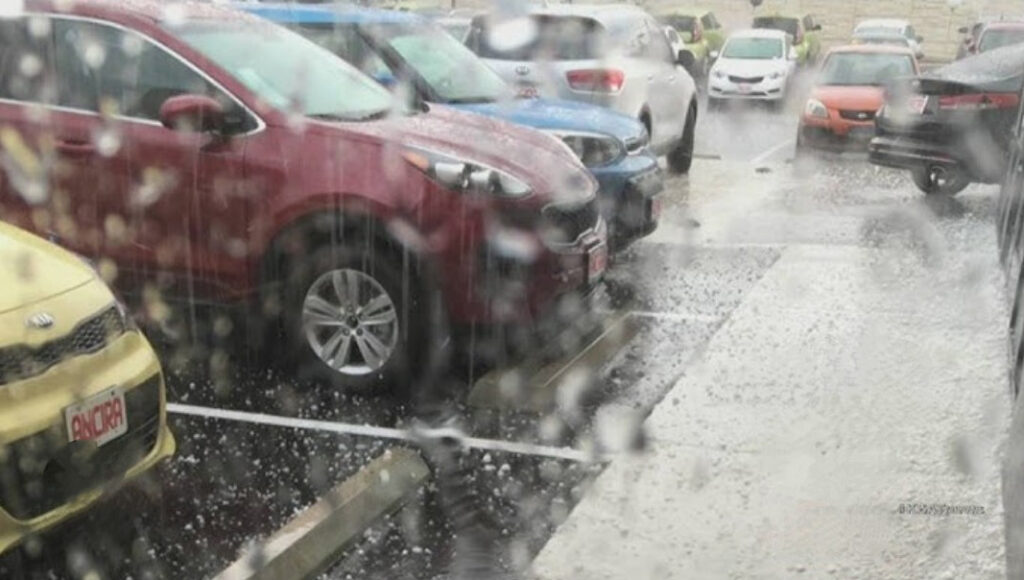
When downpours hit, outdoor shoots stop. Moving cars across a soaked lot kicks dirt and water spots onto detailed paint, so porters re-wash the same vehicle two or three times. That three-to-five-day merchandising delay kills lead momentum.
Every Lost Day Has a Price
Floorplan interest is a meter running on every VIN. With the prime rate at 6.75% in late July 2026 and the average new-vehicle listing price at $49,307, interest alone at a typical floorplan rate runs roughly $11 to $12 per car per day. Add insurance, lot cost, plates and depreciation, and the true holding cost runs several times the interest.
Those days pile up exactly where buyers shop. Google research found 86% of shoppers research a vehicle online before they visit a dealership, and Cox Automotive’s Car Buyer Journey research found buyers spend 60% of their shopping time online. A VDP that says “Photos Coming Soon” is a padlocked showroom.
The software doesn’t take the photo. The weather decides when you can.
The Floating Cartoon Car
Even when a porter braves the cold for an outdoor shot, the AI output looks cheap. Flat gray winter light on the hood clashes with a fake high-gloss CGI floor, leaving fuzzy halos around mirrors and antennas. Buyers spot fake backgrounds instantly, and they wonder what the dealership is hiding.
Shoot Every Day of the Year
Top operators in all three tiers aren’t waiting on sunshine. An indoor 360Booth vehicle photo studio gives you studio lighting, dry panels and immediate 360 spins 365 days a year, no matter what’s falling outside. See the Car Photo Booth or contact us to talk through your market.
How many photo days do dealerships lose to winter weather?
It depends on the region. We estimate dealers in NY, WA, OR, OH, MI and PA lose 60 or more days, the Northeast and Upper Midwest 30 to 60 days, and the Southeast, Southern Plains and Mountain West 15 to 30 days. In Buffalo, NOAA normals show rain or snow on about 62% of January days.
Do AI background apps work in rain and snow?
The app can replace a background, but it cannot take the photo. Someone still has to wash the car and shoot it outside, and rinse water freezes, snow sits on the panels and rain spots the lens.
What does a day without photos cost?
At today’s rates, floorplan interest alone on an average new vehicle runs roughly $11 to $12 a day, and the full holding cost with insurance, lot cost and depreciation runs several times that.
Pull up your recon board. Find the column labeled Photos.
Inspection is there. Used car manager approval is there. Service, parts, body shop and detail are all there. Photos? They just… happen. Eventually. When the weather cooperates and the camera person is in.
Most recon boards skip the photo step
When Dustin Jones of Rapid Recon studied the reconditioning data of 66 dealerships for WardsAuto, he found that few of them had a Photos step in their workflow at all. He called it a missed opportunity for time-to-line improvement.
Here’s why that matters. A step with no column has no owner. No owner, no clock. No clock, and nobody notices the “ready” car with zero pictures online.
Cox Automotive’s Q3 2026 Manheim Used Vehicle Value Index report expects off-lease supply to climb from about 190,000 units a month in the first half of 2026 to about 220,000 in the second half. Lease check-ins at Manheim are up 21% from the same time last year, and they grew from Q2 to Q3 when that quarter normally brings a seasonal dip.
Cox’s read on Q4 is simple: more volume.
More units through recon means more cars that can stall in the one step nobody tracks. If photos already wait on the weather and one person’s schedule at today’s volume, they won’t keep up when the off-lease wave rolls in.
DEALER WAKE UP CALL
A car isn’t frontline-ready until a shopper can see it.
The fastest car to sell is the one that gets online first. Every day a finished car sits without photos is a day it can’t generate a lead, and with values softening this fall, that day costs more than it used to.
Put photos on the board
Give photos their own column. Between detail and sale-ready, where it belongs.
Give the step an owner. One accountable person per shift, not “whoever’s free.” Your process shouldn’t depend on one person either, so train a backup.
Give it a clock. Track time from detail-complete to photos-live, the same way you track every other step.
Make it boring. The same shots, the same order, the same result on every car.
Boring is the goal. A step only stays on schedule when nothing outside it can stop it.
How 360Booth and SHOOTit AI make the photo step boring
SHOOTit AI walks your team through the same 40+ shots on iPhone and stops dark, blurry or off-center frames for a reshoot before anyone leaves the car. That’s quality control at the vehicle, not after the listing goes live. Done once.
How many cars on your lot are “ready” but not photographed?
Sources: Cox Automotive, Q3 2026 Manheim Used Vehicle Value Index report (Oct. 7, 2026); Dustin Jones, “Getting More Out of Used-Car Reconditioning,” WardsAuto (Oct. 2021).
Pull up your aged-inventory list. Pick any unit that has had two price drops. Now open its gallery.
It probably still has the photos it launched with. Dark cabin. Glare across the hood. No tires. No back seat. Then someone knocked $500 off, and the listing went back out with the same bad photos and a smaller number.
Why this hurts more this fall
Cox Automotive’s Q3 2026 Manheim Used Vehicle Value Index report shows wholesale values fell harder than normal in September and dropped below year-ago levels for the first time this year. Cox also cut its year-end forecast from about a 2% gain to about 0.2%.
When values soften, every day a car sits costs more. That makes the urge to cut price stronger, and it makes a wasted price cut more expensive.
Overpriced or under-shown?
A price drop answers one question: is this car worth the number? It doesn’t answer the questions shoppers are actually stuck on. What does the interior look like? How are the tires? Is that a scratch or a reflection?
A markdown can’t brighten an interior or add a missing angle. A fake-perfect background doesn’t fix the car either. It just moves the disappointment to the walkaround, as What If the Background Looked Perfect and the Car Didn’t? explains.
The reshoot-first checklist
Before the next price change on an aged unit, check the gallery:
Is the interior bright enough to see the seats, dash and materials?
If any answer is no, reshoot the car before you reprice it.
A price cut is the most expensive photo edit you’ll ever make
Fix the evidence first. 360Booth controls the light around the real car, so the cabin, paint and wheels show up as they actually are. SHOOTit AI walks your team through the same 40+ shots on iPhone and stops dark, blurry or off-center frames for a reshoot before anyone leaves the car. That’s quality control at the vehicle, not after the listing goes live. Why Should Dealership Vehicle Photography Quality Control Happen at the Vehicle? covers this in more detail.
Then decide whether price is really the problem.
Tonight’s homework
How many cars on your aged list got a price drop before they got a reshoot?
Source: Cox Automotive, Q3 2026 Manheim Used Vehicle Value Index report (Oct. 7, 2026).