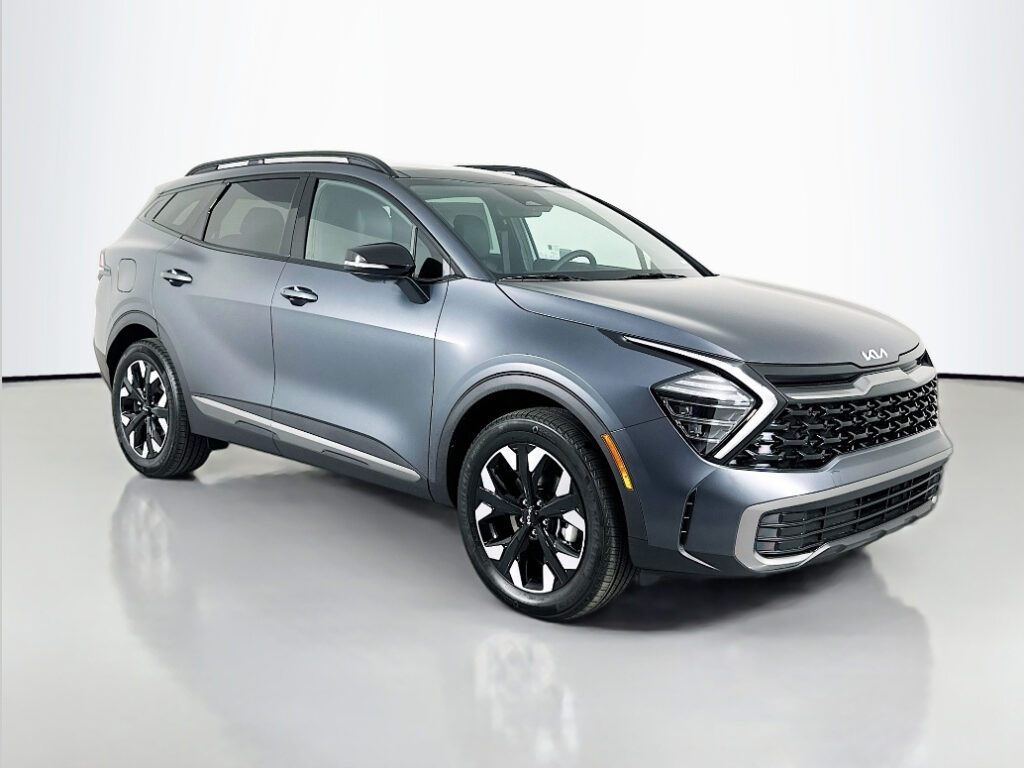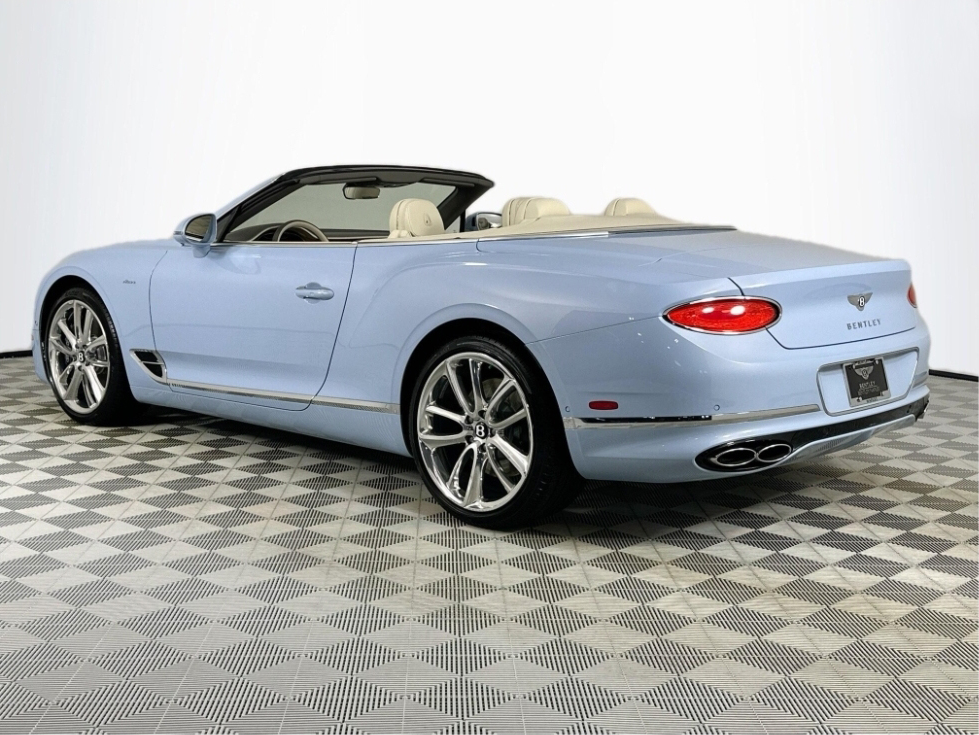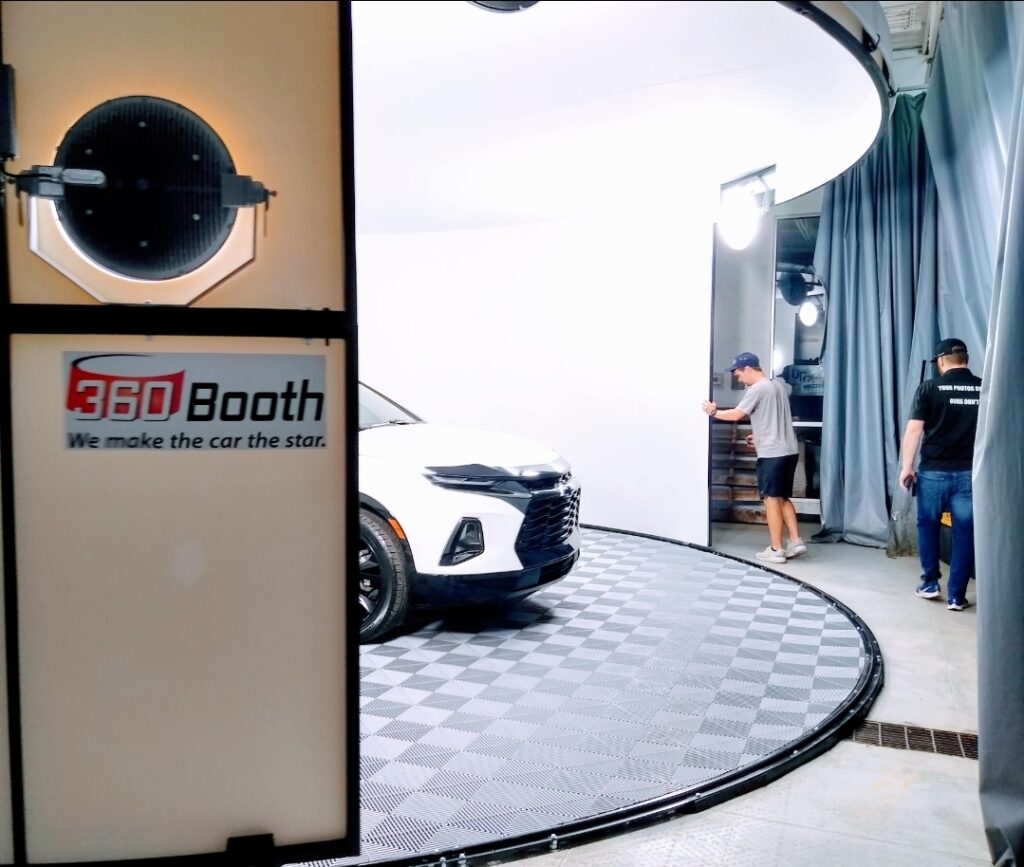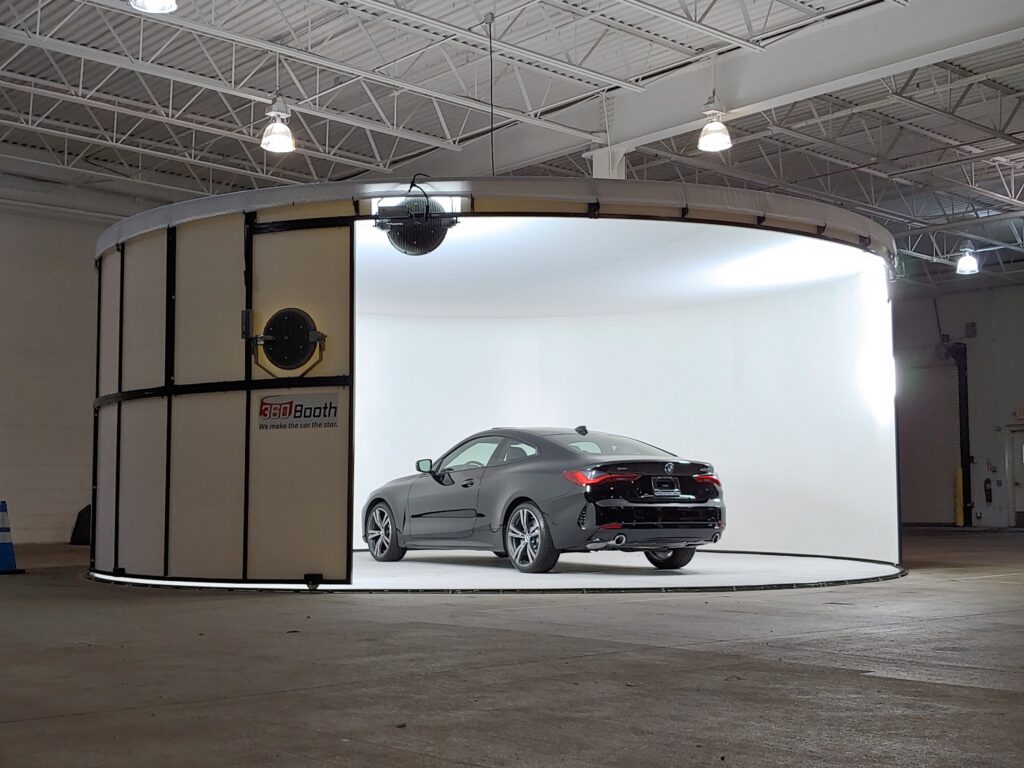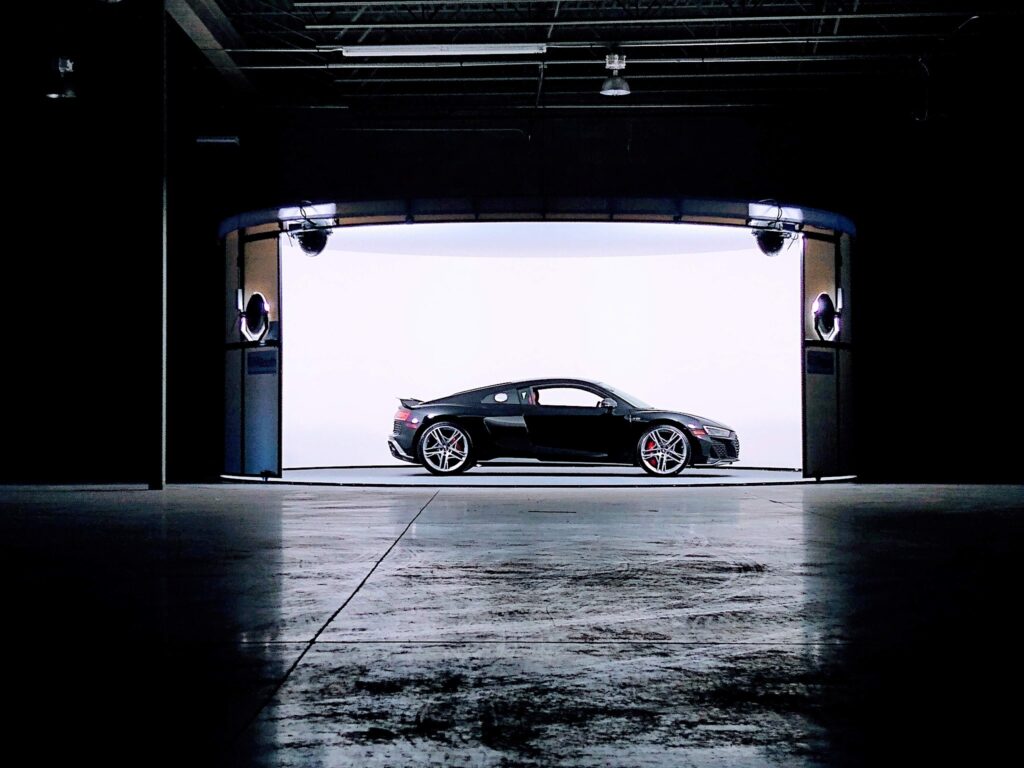
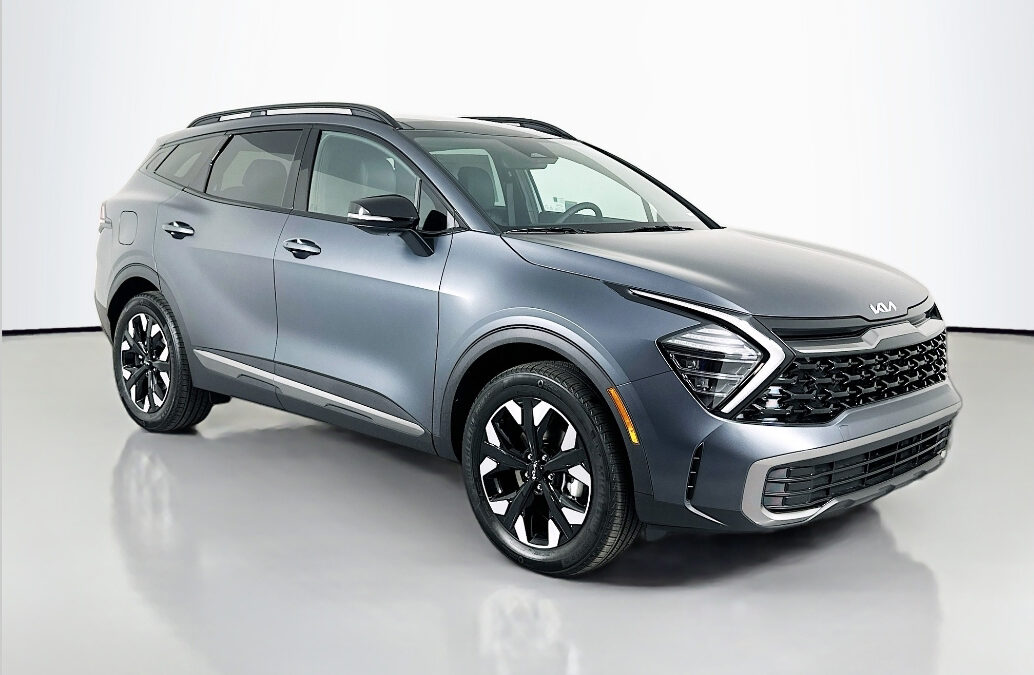
Direct answer: 360Booth uses matte white ePVC wall panels because the surfaces surrounding a vehicle affect its photographed appearance. Matte surfaces reduce sharp reflections from the studio walls, while the neutral white environment supports consistent lighting. Combined with four 5600K LED lighting heads and a diffused white ceiling, the walls help create a repeatable photography environment around the actual vehicle without digitally replacing its surroundings.
Your Vehicle Reflects Everything Around It
A dealership can purchase an expensive camera and still produce inconsistent vehicle photographs.
Why? Because the camera records the light coming from the vehicle, including reflections of its surroundings.
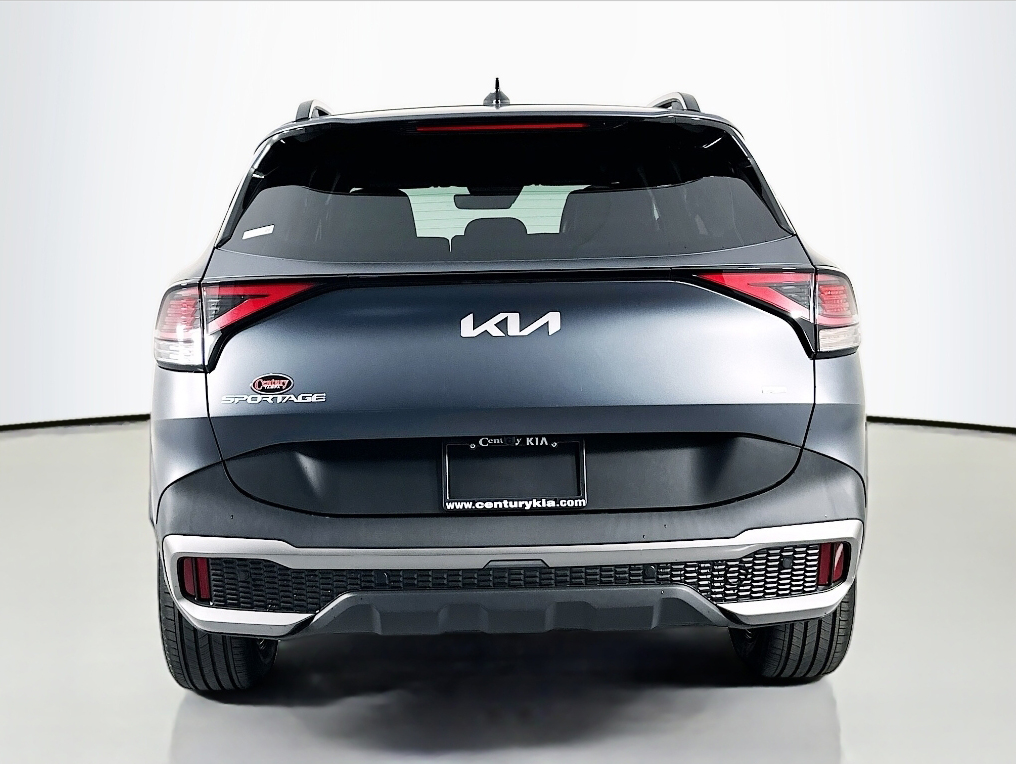
Look closely at a freshly detailed black SUV. You can often see ceiling fixtures, windows, equipment and nearby objects reflected across its painted surfaces.
Move the vehicle into another room, and those reflections change.
The vehicle hasn’t changed. Its surroundings have.
This is one reason the 360Booth vehicle photo studio was designed as a complete physical photography environment instead of simply a white background positioned behind a car.
The room is part of the photography equipment.
Why Matte White Walls Matter
360Booth uses matte white expanded PVC (ePVC) wall panels. The matte finish is intentional.
A glossy surface produces more concentrated, mirror-like reflections. A matte surface scatters reflected light across a wider range of directions.
That difference matters when photographing highly reflective automotive finishes. A shiny wall can introduce additional bright shapes and reflections into the vehicle’s body panels. A matte wall provides a more diffuse surrounding surface.
The purpose isn’t to eliminate every reflection. Reflections are valuable in vehicle photography. They help communicate the shape and curvature of body panels.
The objective is to make those reflections more manageable.
A controlled reflection helps reveal vehicle contours. An uncontrolled reflection can become a distraction or obscure visible details.
Why White Instead of Black or Colored Walls?
White surfaces reflect light broadly and provide a neutral surrounding environment. That supports the studio’s lighting design.
Colored walls can introduce unwanted color into reflections and nearby surfaces. Consider photographing a white vehicle beside a strongly colored wall. Some of that color can appear in the reflected light and the vehicle’s glossy surfaces.
Now photograph the same vehicle inside a neutral white environment. You’ve reduced one source of unwanted color variation.
Black surfaces have legitimate uses in specialized automotive photography because they can create contrast and define body lines. But a dealership needs a repeatable process for photographing different vehicles throughout the day.
360Booth uses a consistent white environment designed around that production requirement. The objective is reliable inventory photography, not rebuilding the lighting setup for every vehicle.
Why Does the Ceiling Use Diffusing Cloth?
The wall panels and ceiling serve complementary purposes.
The studio uses four LED lighting heads with a nominal 5600K color temperature. Above the vehicle is a white diffusing cloth ceiling made from durable polyester.
Rather than relying on harsh, exposed overhead fixtures, the cloth distributes the light more broadly across the photography environment. This helps reduce concentrated highlights and creates a more controlled lighting arrangement.
The ceiling diffuses the overhead illumination. The matte white walls provide a consistent surrounding environment.
Neither component operates independently of the vehicle, camera position or lighting arrangement. That’s why evaluating only the camera specifications tells an incomplete story, and why it belongs on the list of what a dealership should evaluate before buying a vehicle photo studio.
Why Does the 360Booth Structure Move Instead of the Vehicle?
This is another important part of reflection control.
A standard 360Booth does not use a motorized vehicle turntable. The vehicle remains stationary. The surrounding studio structure moves manually on a circular steel track using V-grooved wheels.
That approach primarily reduces mechanical complexity and avoids relying on a powered vehicle-rotation platform. (We cover the operational side in Why Does a Manual Vehicle Photo Studio Work Better?)
It also provides a practical photography advantage. The operator can reposition the surrounding studio structure and lighting environment when necessary. That can help manage reflections or improve lighting for interior photography.
The photographer is controlling the environment around the actual vehicle instead of digitally changing the vehicle after capture.
Do Matte Walls Automatically Reveal Every Scratch or Dent?
No. And this distinction is important for Authentic Capture™.
A controlled lighting environment can help photographers obtain clearer, more consistent views of vehicle surfaces. But detecting a scratch, dent or other imperfection depends on several factors:
- The location and type of damage
- Camera position
- Viewing angle
- Lighting direction
- Image resolution
A matte white studio does not automatically make every surface defect visible. Nor should SHOOTit AI be described as perfectly identifying vehicle condition.
The purpose of the studio is to establish a more predictable environment for capturing evidence. Individual close-up photographs and physical inspection remain necessary when vehicle condition requires additional documentation.
Better photography conditions improve the opportunity to record visible evidence. They do not guarantee complete damage detection. That’s also why the original photographs should be preserved rather than replaced by edited versions.
Why the Physical Studio Still Matters in an AI Photography Workflow
AI can interpret images. It can evaluate certain capture characteristics. It can assist employees in following a required photography sequence.
But it cannot change the physical circumstances under which an original photograph was taken.
That’s the difference between controlling the photography environment and digitally modifying an image afterward.
360Booth controls the physical surroundings. SHOOTit AI guides the evidence-capture process.
The first step in SHOOTit AI is capturing the VIN. The system uses VIN-decoder information to determine which requested equipment photographs are appropriate for that vehicle. If the employee attempts to skip a requested photograph of equipment identified as a standard feature, SHOOTit AI immediately warns the employee to check again.
The system then guides the dealership’s required 40+ image process. When an image is too dark, blurry or poorly centered, SHOOTit AI stops the workflow and immediately prompts the employee to reshoot before continuing. That’s quality control at the vehicle, not after it leaves.
The studio and camera address different problems. One provides the controlled environment. The other provides intelligent capture guidance. Together, they support 360Booth Authentic Capture™.
Does Every Dealership Need Matte White ePVC Walls?
Not every dealership has the space for a complete vehicle photo studio.
A properly planned DIY photography area may be appropriate in some buildings. SHOOTit AI can also guide vehicle photography outdoors.
However, a dealership should understand what it sacrifices when the physical environment becomes less controlled. A painted service bay with overhead fluorescent fixtures, windows and glossy surfaces is not automatically equivalent to a purpose-built studio. Its lighting and reflection characteristics must be evaluated. (Dealer groups mixing studios and DIY areas can see how in How Can a Dealership Group Standardize Vehicle Photography Across Multiple Locations?)
That is where access to more than 50 years of combined vehicle-photography expertise becomes valuable. Our experience includes lighting, color temperature, reflections, camera positioning, iPhone photography, studio installations and DIY photography environments.
The goal is to determine the best practical photography approach for the dealership’s actual building.
What About Maintaining the Wall Panels?
The walls are part of the studio’s photography environment and should be kept clean. Scuffs, dirt and other surface contamination can become visible in photographs or reflected surfaces.
Routine cleaning and inspection should therefore be part of the dealership’s studio upkeep. Damaged or heavily worn panels should be evaluated for replacement when necessary.
Cleaning methods should follow the material and installation guidance rather than relying on aggressive chemicals or abrasive equipment. A clean, consistent physical environment is part of maintaining consistent photographic results.
The Dealer Wake-Up Call
Dealerships spend thousands of dollars buying cameras, software and image-processing services. Then they photograph vehicles in buildings filled with uncontrolled reflections. And wonder why the pictures aren’t consistent.
The camera matters. The software matters. But the physical environment matters too. Even fake background companies admit lighting matters.
360Booth was built around that understanding:
- Matte white walls
- Diffused overhead lighting
- A stationary vehicle
- A manually moving studio
- An intelligent camera guiding the capture process
Before asking AI to improve your vehicle photographs, ask whether you’ve given the camera a proper environment to photograph the vehicle in the first place.
That’s where Authentic Capture™ begins.
FAQ
What material are 360Booth walls made from?
Standard 360Booth wall panels are made from matte white expanded PVC, commonly abbreviated ePVC.
Why not use glossy white wall panels?
Glossy walls can produce stronger, more concentrated reflections. Matte panels provide a more diffuse reflective environment around the vehicle.
Do matte white walls eliminate vehicle reflections?
No. They help control the surrounding reflections. Vehicle paint and glass remain reflective, and camera position and lighting still affect the photograph.
Does 360Booth use natural daylight?
360Booth is designed around controlled studio illumination. Uncontrolled daylight entering through skylights or nearby windows should be evaluated during installation planning.
Does SHOOTit AI require matte white walls?
No. SHOOTit AI works in suitable photography environments independently of 360Booth. The studio provides additional control over physical lighting and surroundings.
Can a vehicle photo studio automatically detect damage?
Not simply because it has controlled lighting. Reliable vehicle condition imaging requires appropriate capture methods, image interpretation and, where necessary, physical verification.
Related Reading:
- Why Should Dealerships Preserve Original Vehicle Photographs After Publishing Inventory Online?
- What If the Background Looked Perfect and the Car Didn’t?
- Why Does a Manual Vehicle Photo Studio Work Better?
- Why 360Booth Does Not Use a Turntable
- What Should a Dealership Evaluate Before Buying a Vehicle Photo Studio?
- Fake Background Companies Say Lighting Matters. Then They Take Away Your Studio.
- Why Should Dealership Vehicle Photography Quality Control Happen at the Vehicle?
- How Can a Dealership Group Standardize Vehicle Photography Across Multiple Locations?