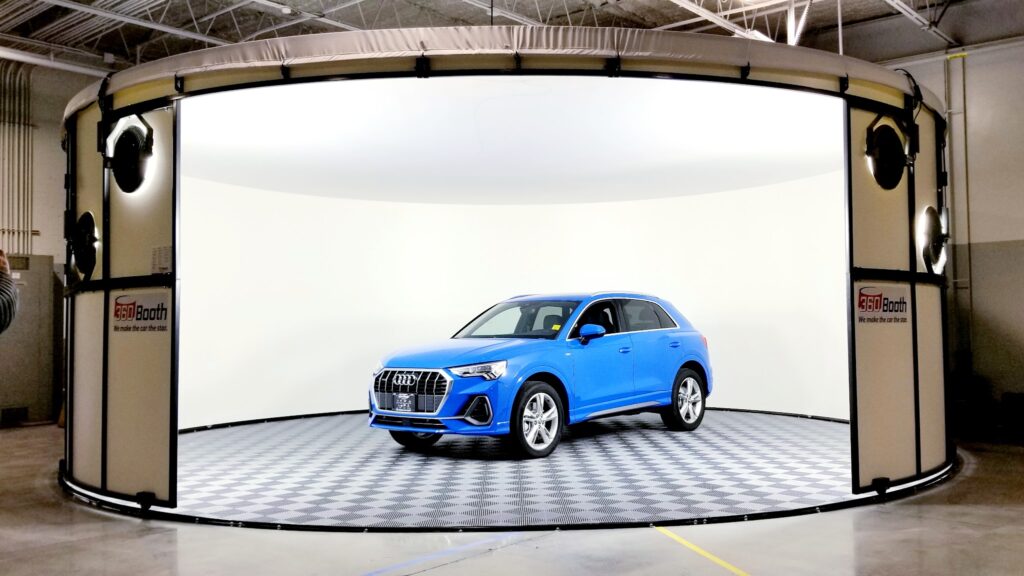
A competing studio company published a comparison of its product against 360Booth. We read it. It’s wrong about us.
When a competitor needs to get your specs wrong to win the comparison, that tells you something about the comparison. So here are the facts, straight from the people who build the studio.
What they said vs. what’s true
They said: 360Booth has a limited warranty. The fact: 360Booth carries a 5-year unconditional warranty. Not limited. Unconditional.
They said: 360Booth has extra integration costs. The fact:There is no integration fee. None.
They said: 360Booth has two wall lights. The fact: Our 26 ft and 28 ft studios run four LEDs at 200,000 lumens.
Three claims. Three misses. If a vendor can’t get the competition right, ask how carefully they’re describing their own product.
“Real, not AI”? Read the product list.
Some studio companies market themselves as the real alternative to AI. Then you look at what they actually sell: AI background replacement, and a feature that reuses one car’s photos on other matching vehicles in your inventory.
Think about that second one. A shopper looks at a listing and sees photos of a different car. Same trim, same color, not the car on your lot. That’s not real. That’s a stock photo with your VIN on it.
Before you sign with any studio, put its website pages side by side. If the same system is listed with 12 cameras on one page and 16 on another, a capture time of 2 seconds here and 45 seconds there, and a lumen rating that changes by the page, ask one question:
“Which of these numbers goes in my contract?”
If they can’t answer it, you have your answer.
Rent forever, or own it?
Some studios are rented by the month, for as long as you shoot. Some still charge per VIN, with volume minimums. Every car you photograph is another line on the invoice.
A 360Booth is different:
You own the studio outright
No monthly invoice for the studio
No per-VIN fees
No contracts
Zero cost for on-site visits
5-year unconditional warranty
Add SHOOTit AI for one flat monthly invoice with no contract and no credit card required: unlimited vehicles, unlimited photos per vehicle, unlimited interior and exterior 360 videos and unlimited training.
Do you want a studio, or a construction project?
Ask any studio vendor exactly what installation takes. Some drive-thru systems need dedicated electrical circuits, a forklift on site for days, and a metal building that eats a row of parking spaces. Then ask who handles the permits.
Get it in writing before your service manager finds out the hard way.
Ask the right questions
Any studio, ours included, should be able to answer these without hesitation:
What exactly does your warranty cover, and for how long?
Is there an integration fee?
Do you charge per VIN, and is there a minimum?
Do you sell AI background replacement or reuse photos across vehicles?
Which camera count, capture time and lighting spec will be in my contract?
What does installation require, and who pulls the permits?
If you’re comparing studios, compare facts. Ours are simple: own it outright, 5-year unconditional warranty, no integration fee, four LEDs at 200,000 lumens, and real photos of the real car.
FAQ
What warranty does 360Booth have?
360Booth carries a 5-year unconditional warranty. It is not a limited warranty.
Does 360Booth charge an integration fee?
No. There is no integration fee with 360Booth.
How much lighting does a 360Booth studio have?
The 26 ft and 28 ft 360Booth studios use four LEDs at 200,000 lumens.
Does 360Booth charge per VIN or require a monthly rental?
No. You own the 360Booth studio outright, with no per-VIN fees, no monthly studio invoice and no contracts.
Direct Answer: After you submit a 360Booth contact form, our team reviews your vehicle photography needs, discusses studio options and pricing, and evaluates your proposed space using your photos and measurements. As the project moves forward, we coordinate a walk-through visit, document the site findings, prepare your layout and quote, confirm installation readiness, schedule shipping and installation, and arrange training and SHOOTit AI setup so your team can start photographing vehicles.
The 13 Steps at a Glance
Your inquiry is received.
Your project information is organized.
We discuss your needs.
You receive product information and pricing.
You provide photos and measurements.
A walk-through visit is coordinated.
Your location and studio configuration are evaluated.
The site findings are documented.
Your layout and quote are prepared.
Your order and payment arrangements are confirmed.
Your installation readiness is checked.
Shipping and installation are coordinated.
Your studio is installed and your team gets started.
Here’s what each step looks like, from your first inquiry to photographing vehicles.
Phase 1: Understanding Your Dealership
Step 1: What happens when my inquiry is received?
Your contact form starts the conversation about a 360Booth vehicle photo studio for your dealership or automotive business.
Most dealers reach out because their current photography process is slow, inconsistent or dependent on the weather. If you’re still deciding whether a studio makes sense, start with why it’s so helpful to have a 360Booth vehicle photo studio.
Step 2: How is my project information organized?
Your contact details, dealership information and project notes are kept together so the team can coordinate follow-up without asking you the same questions twice.
That same single-point coordination continues after installation. See how the studio, the camera, the data team and customer support work as one connected vehicle photography system.
Step 3: What do we discuss about my needs?
We review your current photography process, vehicle volume, available space and timing to understand what your operation requires.
Measurements, photos and preparation requirements become the working reference for your project. Any items that need attention are identified before installation, not on installation day.
Once you accept the quote, invoicing and payment arrangements are coordinated according to your order terms. Orders are placed through the 360Booth order form.
Step 13: What happens when my studio is installed?
The installation team assembles the studio. Training, SHOOTit AI setup and data-feed coordination are arranged as needed to get your vehicle photography operation running.
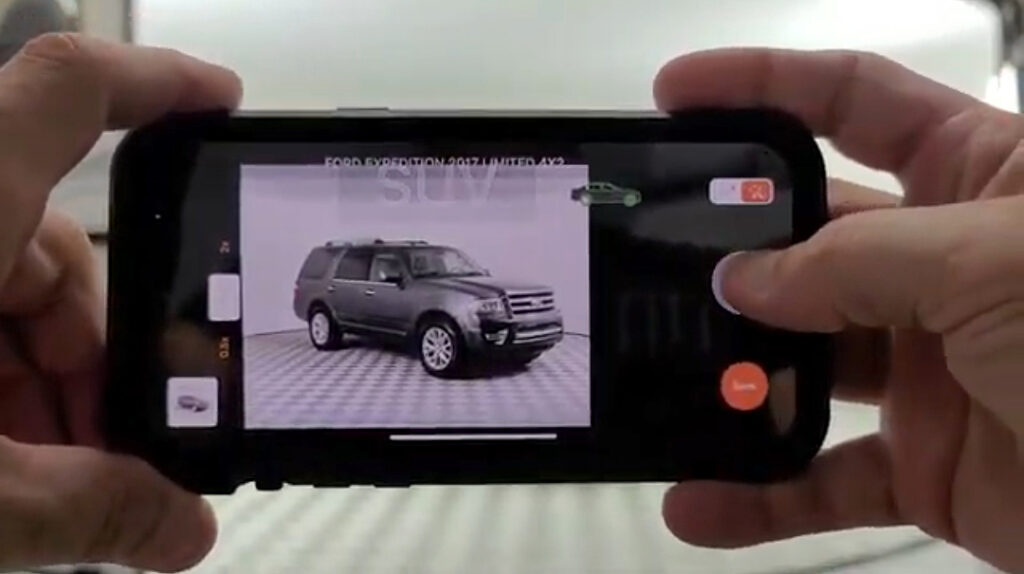
From there, SHOOTit AI guides your team through each required image on an iPhone and prompts a reshoot when an image is too dark, blurry or poorly centered. Learn more:
Contact 360Booth to request product information or book a walk-through visit. The sooner we see your space, the sooner we can identify what your site needs before installation day.
FAQ
What happens after I submit a 360Booth contact form?
The 360Booth team reviews your vehicle photography needs, discusses studio options and pricing, and evaluates your proposed space. As the project moves forward, the team coordinates a walk-through visit, layout and quote, installation readiness, shipping, installation and training.
What information should I have ready for the first conversation?
It helps to know your current photography process, monthly vehicle volume, the space you’re considering and your preferred timing.
Do I need to send photos and measurements of my space?
Yes. Photos, basic dimensions and any available floor plans help the team evaluate the proposed location and identify questions before the walk-through visit.
What does the 360Booth site evaluation check?
The evaluation reviews studio placement, vehicle access, floor conditions, overhead obstructions and electrical requirements to determine the appropriate studio configuration.
What electrical service does a 360Booth studio need?
A standard U.S. installation needs a dedicated 110V, 20A circuit and a one-hour timer switch, prepared by the dealership’s local electrician before installation day. See the electrical requirements.
What must be ready before the studio is delivered?
The installation area must be clear, electrical work must be complete, and delivery access and unloading arrangements must be in place.
Is training included after installation?
Training, SHOOTit AI setup and data-feed coordination are arranged as needed so your team can start photographing vehicles.
Buying a vehicle photo studio shouldn’t come down to who has the most cameras, motors, computers or automation.
Dealers should ask a different question: How quickly, reliably and consistently can we create the complete set of vehicle images our customers need?
After 28 years in automotive inventory photography and more than 1,700 360Booth installations across six countries, we’ve learned that the best technology often isn’t the most complicated technology.
Here are 10 questions every dealership should ask when comparing 360Booth® + SHOOT it AI with any other vehicle photography system.
1. How many vehicles per hour can a dealership photograph with 360Booth?
Be careful with advertised “capture time.” A company may advertise how quickly several cameras can fire without explaining how long it takes to produce the complete merchandising package.
360Booth + SHOOT it AI is designed around the entire vehicle photography workflow. A trained user can capture 40+ still photographs, an interior 360 and an exterior 360 in approximately 1 minute and 20 seconds. That is the number dealers should compare: not how quickly one camera fires, but how quickly the dealership can create the media it actually needs.
2. How long does a complete vehicle photography session take?
Proof matters more than promises.
Using SHOOT it AI with 360Booth, we have demonstrated:
142 exterior 360 images plus video in approximately 25 seconds
40+ still photographs
Interior 360 capture
Exterior 360 capture
Approximately 1 minute and 20 seconds for the complete capture process
3. Does a dealership need a dedicated photographer?
Our objective is the opposite. We’ve spent 28 years learning how dealership inventory photography actually works. A system that requires a highly trained photographer can create another labor bottleneck.
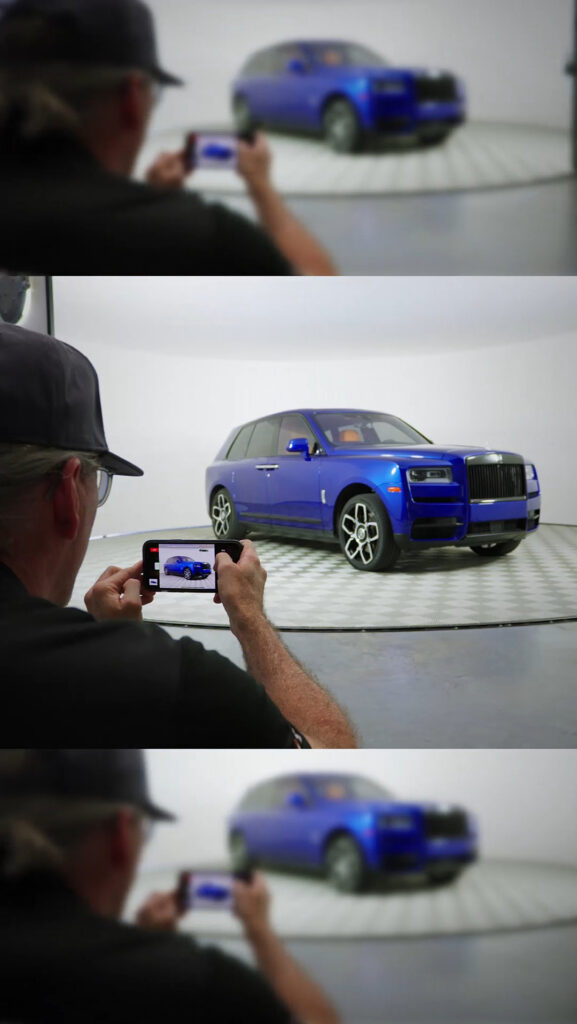
With 360Booth and SHOOT it AI, a detailer or dealership employee can drive the vehicle into the studio, pick up the intelligent camera and follow the guided capture process.
SHOOT it AI helps standardize the process so the technology carries more of the photographic knowledge.
The scalability is real. One auction operation in Perth, Australia has photographed as many as 80 vehicles in a day using the 360Booth workflow.
4. Fixed multi-camera system or an intelligent moving camera?
This is one of the biggest differences dealers should understand.
A fixed multi-camera system achieves speed by positioning numerous cameras around the vehicle. 360Booth takes a different approach.
The vehicle remains stationary while the 360Booth photography environment and photographer move around it.
SHOOT it AI adds intelligence to that process by helping:
Optimize the path around the vehicle
Dynamically adjust image capture
Identify images that are too dark or blurry
Prompt the user when another image is required
Center the vehicle
Maintain consistent exterior framing
Capture dozens of different vehicle details without being restricted to fixed camera positions
There is another benefit: lighting and reflections change as the 360Booth moves around the vehicle.
Automobiles are among the most reflective products dealerships photograph. Managing those reflections matters.
More cameras don’t automatically mean better photography. Sometimes they simply mean more cameras.
5. Can 360Booth photograph VINs, wheels, damage and unique vehicle features?
Absolutely. A vehicle isn’t a standardized box.
One car may need a photograph of carbon-ceramic brakes. Another may need third-row seating, a panoramic roof, special stitching, a window sticker, tire condition, a scratch, a wheel, an engine compartment or a particular option.
SHOOT it AI isn’t restricted to what a collection of permanently mounted cameras can see.
The photographer can capture:
VINs, wheels, tires, scratches, dents, options, dashboards, seats, engines, cargo areas, third rows, window stickers and other vehicle-specific details.
Our philosophy is simple:
Automation should help the photographer—not restrict what the dealership can photograph.
6. Which vehicle photo studio produces better photographs?
Speed means very little if the resulting photographs aren’t good.
Vehicle photography is fundamentally about light and reflection management. Dark paint, glossy surfaces, glass, chrome and windshields can expose weaknesses in a poorly designed lighting environment.
360Booth uses powerful LED illumination combined with engineered diffusion to create a bright environment while controlling harsh reflections. Our lighting system uses four high-output LED sources rated at approximately 50,000 lumens each, combined with the 360Booth’s diffusion system.
The objective is simple:
Accurate color.
Clean reflections.
Visible vehicle details.
Clear glass.
Consistent exposure.
Professional presentation.
And because the 360Booth moves around the stationary vehicle, the relationship between the light, walls, camera and reflective vehicle surface changes throughout the photography sequence.
Don’t evaluate a vehicle photo studio by looking at the studio. Evaluate the cars photographed inside it.
7. What is the true cost of owning a vehicle photo studio?
Purchase price isn’t the same thing as cost of ownership.
Dealers comparing systems should ask about:
Motors.
Turntables.
Camera replacement.
Calibration.
Computers.
Control equipment.
Maintenance.
Service calls.
Software obligations.
Long-term contracts.
Downtime.
360Booth was deliberately engineered around mechanical simplicity.
Buy the 360Booth and the studio is yours. There is no studio lease and no long-term equipment contract required to continue owning the physical studio.
360Booth also provides an unlimited five-year warranty, designed to protect the dealership from unexpected equipment costs during the first five years.
Before signing a five-year agreement for a complicated automated system, calculate what you will actually spend over those five years. Compare total cost of ownership—not monthly payment.
8. What happens when the photo studio breaks?
This might be the most overlooked question in vehicle photography.
A dealership can have the fastest studio in the world, but if the system is down, its production speed becomes zero.
360Booth has:
No powered turntable.
No turntable motor.
No complicated drive mechanism moving the vehicle.
The studio travels manually around its steel track with approximately 20 pounds of pressure.
We have 360Booth installations that have been operating for approximately 13 years, photographing enormous numbers of vehicles. Even the lighting system was designed with redundancy in mind.
Four approximately 50,000-lumen LED sources create substantial illumination. If one lighting component requires service, the dealership isn’t necessarily faced with an unusable photography environment.
That’s an important distinction.
Reliability isn’t how impressive equipment looks when everything works. Reliability is what happens when something doesn’t.
9. How quickly can 360Booth photographs reach the dealership’s VDP?
Capture speed is only one part of speed-to-market.
SHOOT it AI was designed around eliminating unnecessary steps throughout that chain.
The operator follows an optimized route around the vehicle. Images are processed using our computer-vision and AI systems. The photography sequence can be standardized. Images can then enter the dealership’s data-feed workflow.
There will always be downstream variables outside the studio’s control, including how frequently a dealership’s website or inventory provider accepts updated feeds.
That’s why we don’t believe in pretending every downstream system operates instantaneously.
What we can control is our portion of the workflow.
Our in-house data experience goes back 28 years, and support is a fundamental part of the system. The fastest camera doesn’t necessarily create the fastest VDP. The fastest complete workflow does.
10. Why should a dealership choose 360Booth?
Because automotive photography doesn’t need to become more complicated to become more intelligent.
360Booth combines a mechanically simple vehicle photo studio with SHOOT it AI intelligent-camera technology.
The physical system concentrates on what a studio should do exceptionally well:
Light the vehicle. Control the environment. Manage reflections. Remain reliable.
SHOOT it AI concentrates on what software should do:
Guide capture. Improve consistency. Detect problems. Optimize workflow. Process images. Reduce human error.
That combination has been built on 28 years of automotive photography experience, rather than adapting a generic imaging system to dealerships.
Today, that experience includes:
1,700+ 360Booth studios installed across six countries and more than 2,500 users.
So when comparing 360Booth with any other vehicle photo studio, don’t simply ask: “Which one takes pictures fastest?”
Ask:
How fast can it produce my complete photo set?
How good are those photographs?
Can my existing employees operate it?
Can I photograph anything I want?
What happens when something breaks?
What will I spend over five years?
How quickly will my inventory actually reach the VDP?
And perhaps the most important question:
Am I buying technology that simplifies my photography operation—or technology that makes a simple job more complicated?
At 360Booth, our philosophy after 28 years remains remarkably simple: Light it. Shoot it. Upload it.
360Booth® + SHOOT it AI: AI-assisted. Real-world captured.
FAQ
What is the most important question when buying a vehicle photo studio?
How quickly, reliably and consistently the dealership can create the complete set of vehicle images customers need, not how many cameras or motors the system has.
Does a dealership need a dedicated photographer for a 360Booth?
No. With 360Booth and SHOOTit AI, a detailer or other employee can drive the car in, pick up the intelligent camera and follow the guided capture process.
Can a 360Booth photograph VINs, wheels, damage and unique features?
Yes. Because the camera isn’t fixed in place, the photographer can capture VINs, wheels, tires, scratches, dents, options, dashboards, seats, engines, cargo areas, third rows and window stickers.
What should be included in total cost of ownership?
Motors, turntables, camera replacement, calibration, computers, control equipment, maintenance, service calls, software obligations, long-term contracts and downtime.
What happens if a 360Booth breaks down?
There’s no powered turntable or drive mechanism. The studio moves manually on a steel track, and the lighting uses four LED sources, so one light needing service doesn’t necessarily stop photography.
Direct answer: Yes, a 360Booth vehicle photo studio can potentially be installed over concrete with radiant in-floor heating, but the heating system must be evaluated before anyone drills or anchors the studio track. Heating tubes, electrical heating elements and other embedded systems need to be located and documented first. Professional concrete scanning, careful installation planning and the right fastening method all reduce the risk of damaging the floor.
The Floor Looks Empty. What’s Underneath It?
A dealership finds the ideal spot for a 360Booth vehicle photo studio.
The room is big enough. The ceiling is high enough. The vehicle entrance works. The lighting can be controlled.
Everything looks ready.
Then someone mentions the building has radiant heating embedded in the concrete floor.
That changes the conversation. The question is no longer whether the studio fits. It’s what might be damaged when the track is secured.
Before you install equipment on a concrete floor, understand what’s inside that floor.
How Is the 360Booth Track Installed?
A standard 360Booth does not use a motorized vehicle turntable. The vehicle stays stationary while the studio structure moves around it by hand.
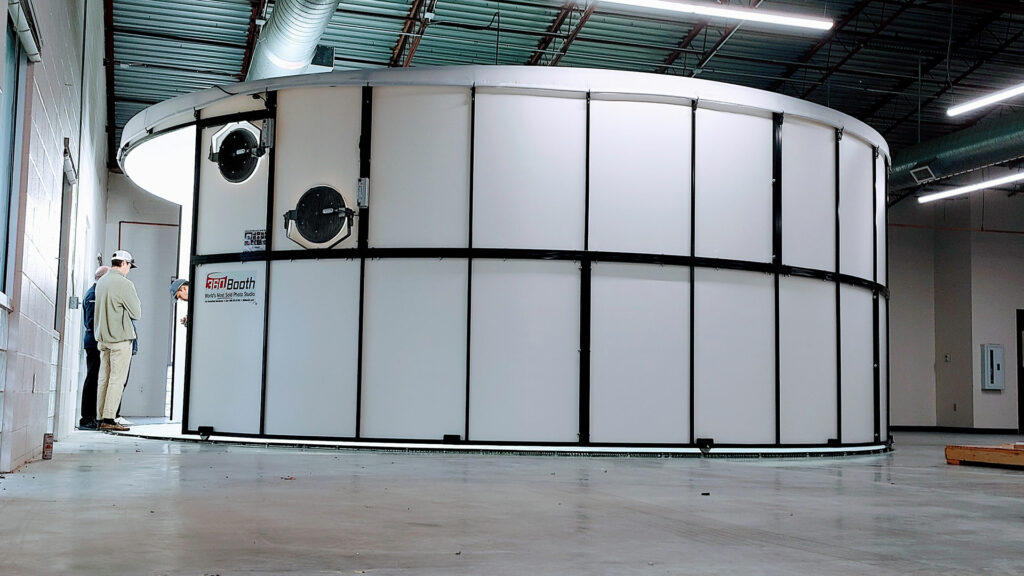
The structure rolls on V-grooved wheels along a circular track made of black powder-coated steel. That track sits on top of the existing concrete, so the dealership doesn’t need to build a recessed turntable pit.
During installation, the track is positioned, leveled with shims and secured to the floor with concrete anchors.
That’s straightforward when the concrete is suitable. Concrete with concealed heating needs more investigation first.
Why Does Radiant Floor Heating Matter?
Radiant floor heating uses either water-filled tubing or electrical heating elements installed in or beneath the concrete. Once the floor is poured, you can’t see them. A contractor looking at the finished surface can’t reliably tell where they run.
Drilling into a heating tube can cause a leak.
Damaging an electrical heating element can create an electrical hazard and knock out the heating system.
Repairing either one may mean opening up the finished floor.
That’s why in-floor heating has to be identified before installation starts. The same goes for other concealed components, such as electrical conduit, reinforcing steel and post-tensioning tendons. A floor that looks suitable isn’t proof that it is.
What Should Be Done Before Installation?
1. Identify the existing heating system
Confirm whether the proposed studio area has radiant heating. Building drawings, renovation records and the facility manager are good places to start. The installation team needs a general picture of the system before planning where anchors go.
If the building has been renovated, the original drawings may no longer match what’s in the floor. Documentation is a starting point, not proof that every concealed component has been found.
2. Arrange professional concrete scanning
A qualified concrete-scanning provider should evaluate the area where the track will be anchored. Ground-penetrating radar (GPR) is a common method for locating radiant heating tubes, conduit and other objects inside concrete. Scanning providers typically mark what they find directly on the floor so the installer can plan around it.
3. Document where the embedded components are
The scan results should show the area evaluated and mark every detected component. Keep that documentation and share it with the 360Booth installation team before anchor locations are finalized.
Marking the floor doesn’t help if the results never reach the people doing the work. The goal is for the person planning the installation and the person drilling to have the same information.
4. Agree on an approved installation plan
The installation team evaluates the actual floor conditions and decides whether a suitable anchoring arrangement is possible. Fastener type, placement and penetration depth are project-specific. They depend on the slab construction and where the embedded systems are.
Where structural conditions call for it, the building’s engineer or another qualified construction professional should review the plan.
If the heating system can’t be adequately located, installation doesn’t proceed on the assumption that drilling will be safe.
Does Concrete Scanning Guarantee Nothing Will Be Damaged?
No. Scanning is an important way to reduce risk, but it can’t promise that every concealed object will be found.
Results depend on the concrete mix, reinforcement, how deep the targets are, the tubing material, the scanning equipment and the operator’s experience. Closely spaced or deeply embedded objects can be hard to pick up.
A qualified scanning professional should note any areas of uncertainty. When a critical component can’t be located with confidence, drilling stops until the question is resolved.
A scan is evidence for planning. It isn’t permission to guess.
Does a Heated Floor Change the Photography Process?
No. Once the studio is installed, daily photography works the same as in any other building.
360Booth provides the controlled environment: the vehicle stays put while the studio moves, lit by four 5600K LED lighting heads under a diffusing white ceiling. SHOOTit AI guides the capture, starting from the VIN, walking the employee through the dealership’s 40+ image sequence and stopping for a reshoot when an image is too dark, blurry or off-center.
The heating in the slab is an installation consideration. It doesn’t add a single step to daily photography.
Why Site Planning Matters
Dealerships usually judge a potential studio location by space. That’s necessary, but it’s not the whole picture.
A standard 24-, 26- or 28-foot 360Booth needs a minimum clear room of 30 feet long (in the vehicle-entry direction) by 30 feet wide by 11 feet high. The studio itself stands 10 feet tall, with standard entrance openings of 14, 16 and 18 feet respectively.
A vehicle photo studio should be simple to operate. That doesn’t mean its installation should be handled casually.
The last thing a dealership needs is a damaged heating system because nobody asked what was under the concrete.
We’ve spent more than a decade installing vehicle photo studios in all kinds of dealership buildings. Every building is different. Our job is to find those differences before they become installation problems. Here’s how that process starts.
The smartest installation begins with understanding the building, not discovering what’s under the floor with a drill. That’s how you protect the facility and give 360Booth Authentic Capture™ a long-term home.
FAQ
Can 360Booth be installed over radiant floor heating?
Potentially, yes. The heating system must be located and evaluated before an approved installation and anchoring plan is set.
Does the 360Booth track sit inside the concrete?
No. The standard track sits on top of the existing concrete. It doesn’t need a recessed turntable pit.
Does 360Booth use concrete anchors?
Yes. The standard installation anchors the track to the floor. The final fastening arrangement has to suit the specific floor.
Can ground-penetrating radar locate radiant heating pipes?
It can help locate embedded tubing and other concealed components. How well it works depends on the slab construction and scanning conditions.
Does scanning guarantee the heating system won't be damaged?
No. Scanning reduces uncertainty but can’t guarantee every component is found. Unresolved areas need more evaluation before anyone drills.
Should the dealership arrange scanning before installers arrive?
Yes. When in-floor heating or other embedded systems are known or suspected, scanning should be coordinated during installation planning.
Does radiant floor heating interfere with SHOOTit AI?
No. Floor heating is a building infrastructure issue. SHOOTit AI’s guided camera workflow is completely separate from how the track is anchored.