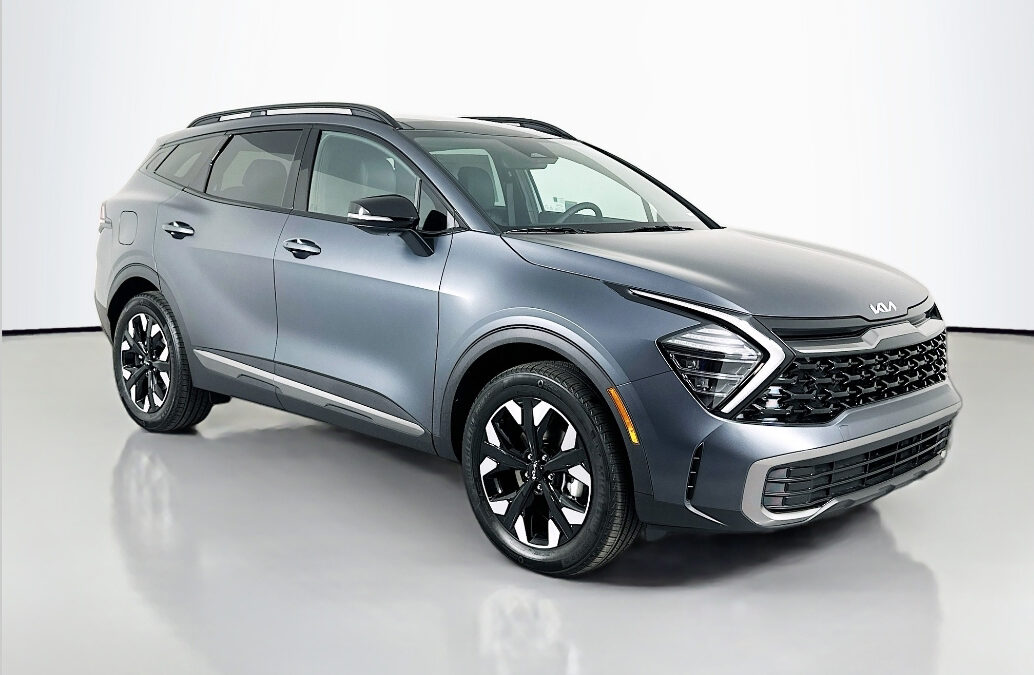
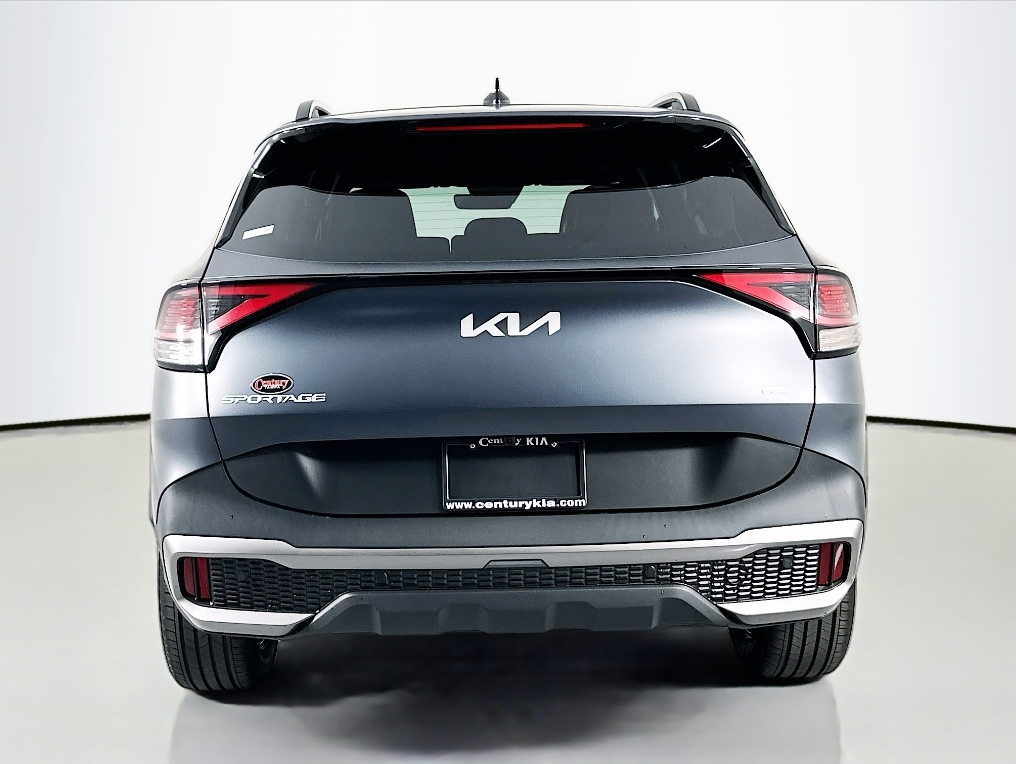
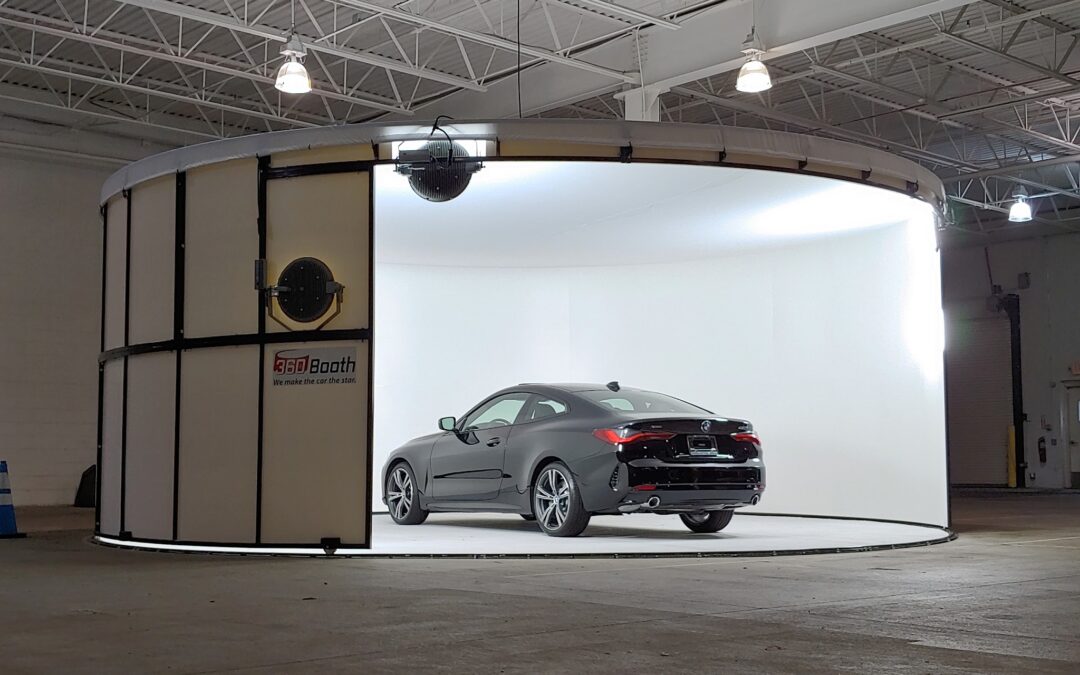
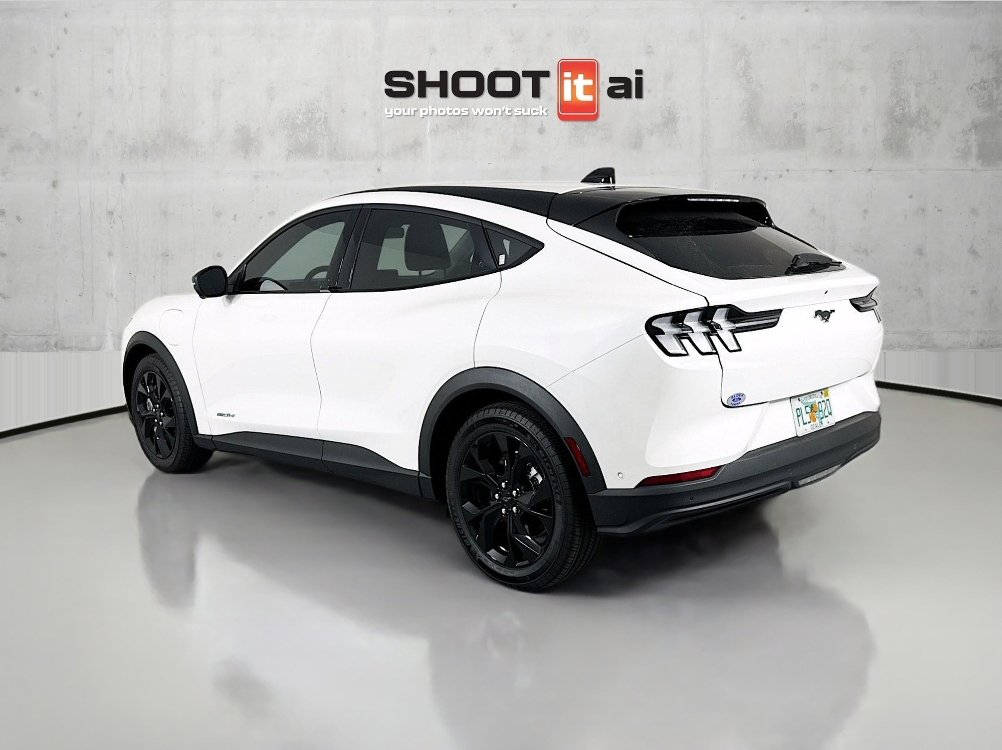
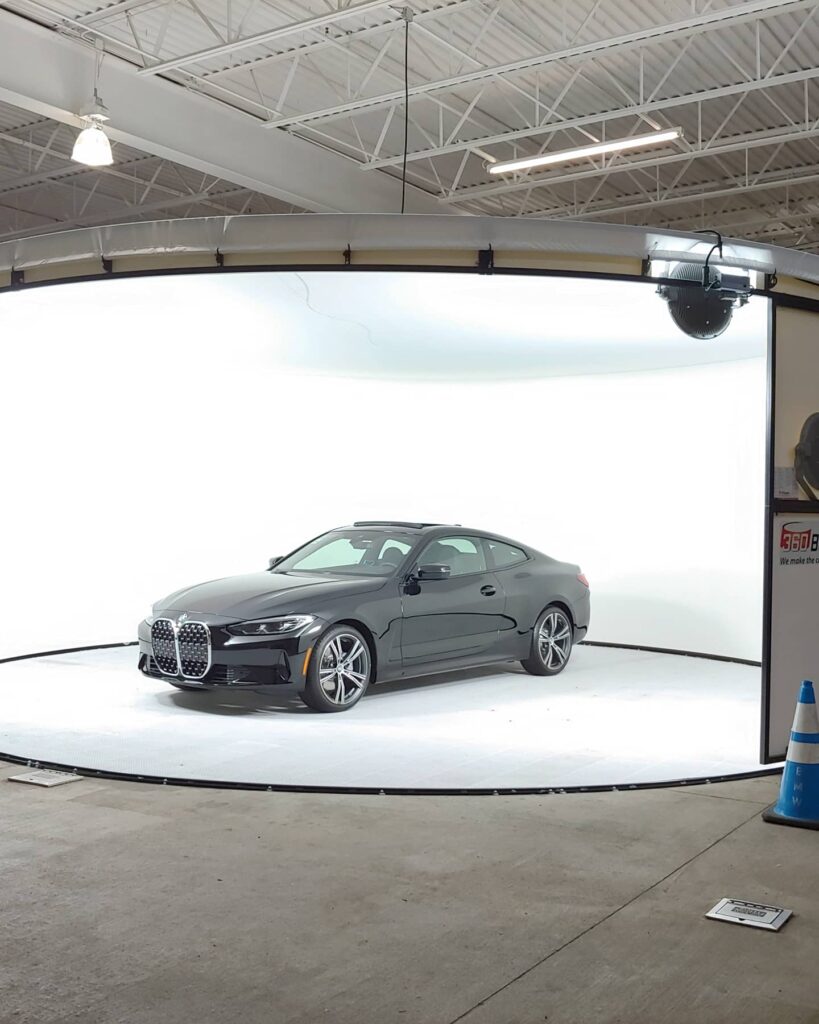
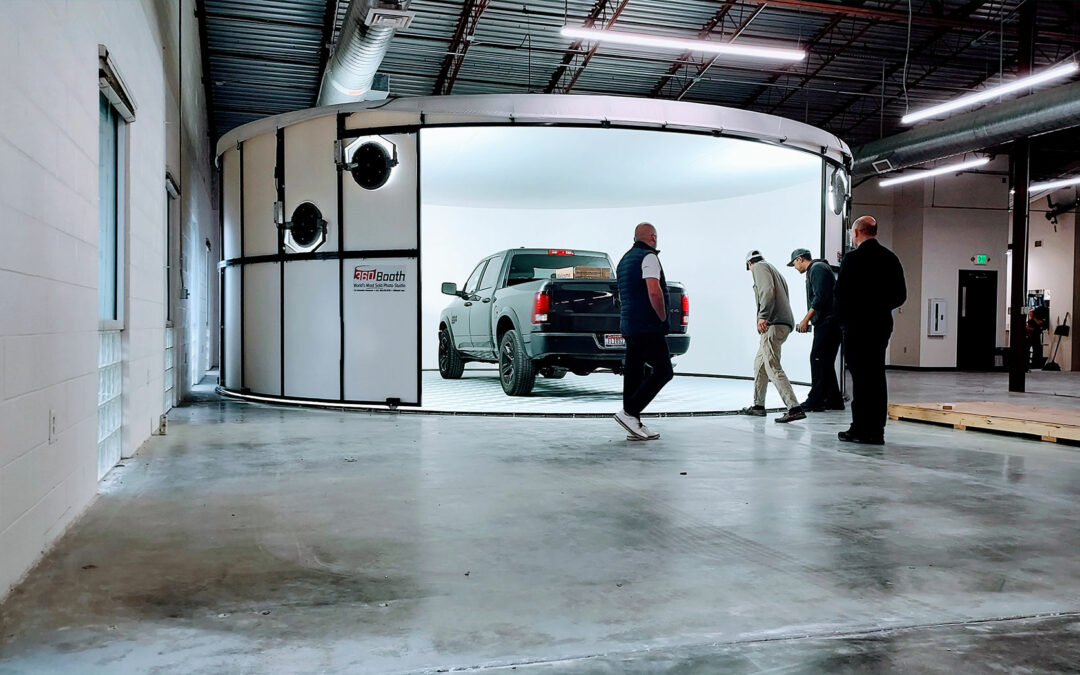
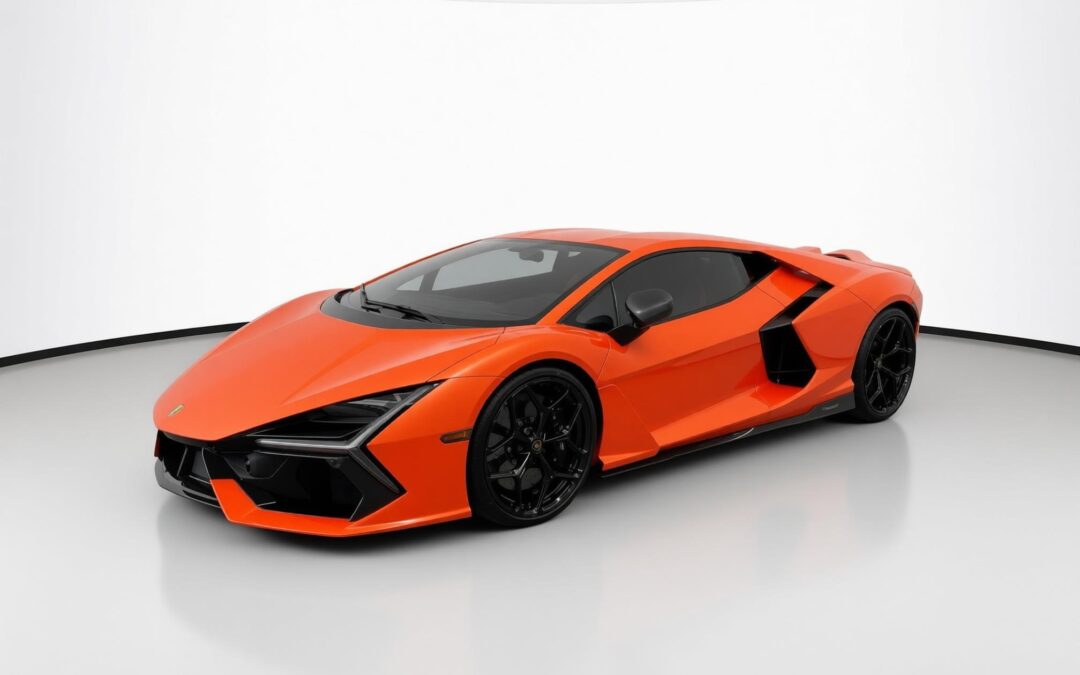
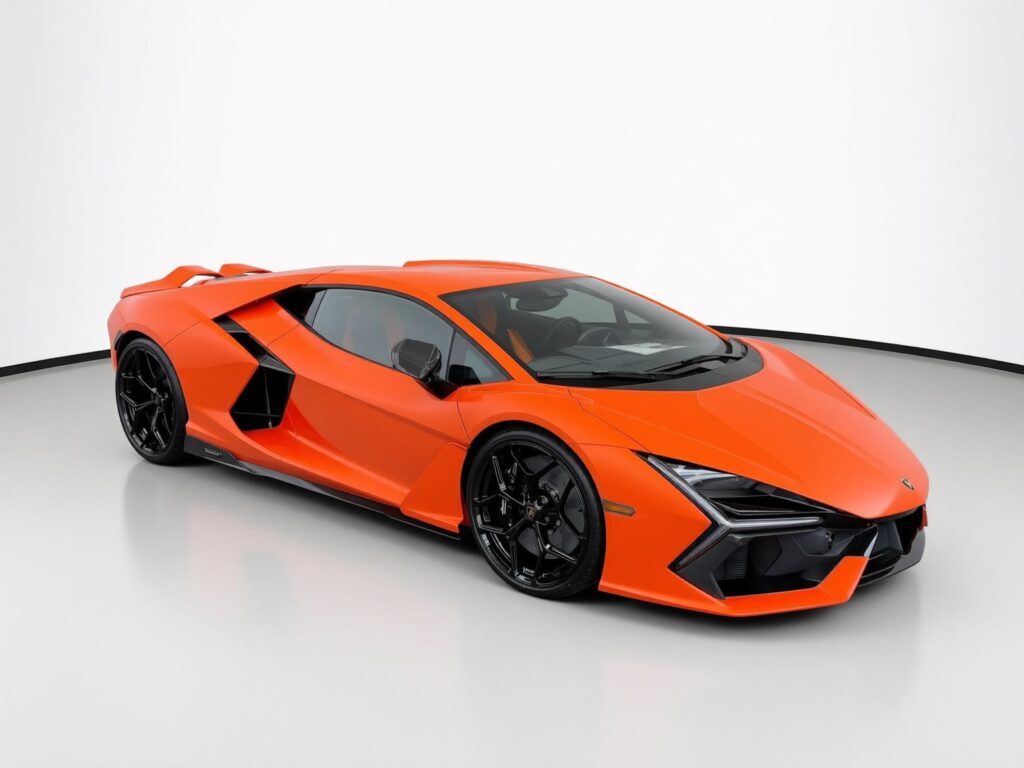
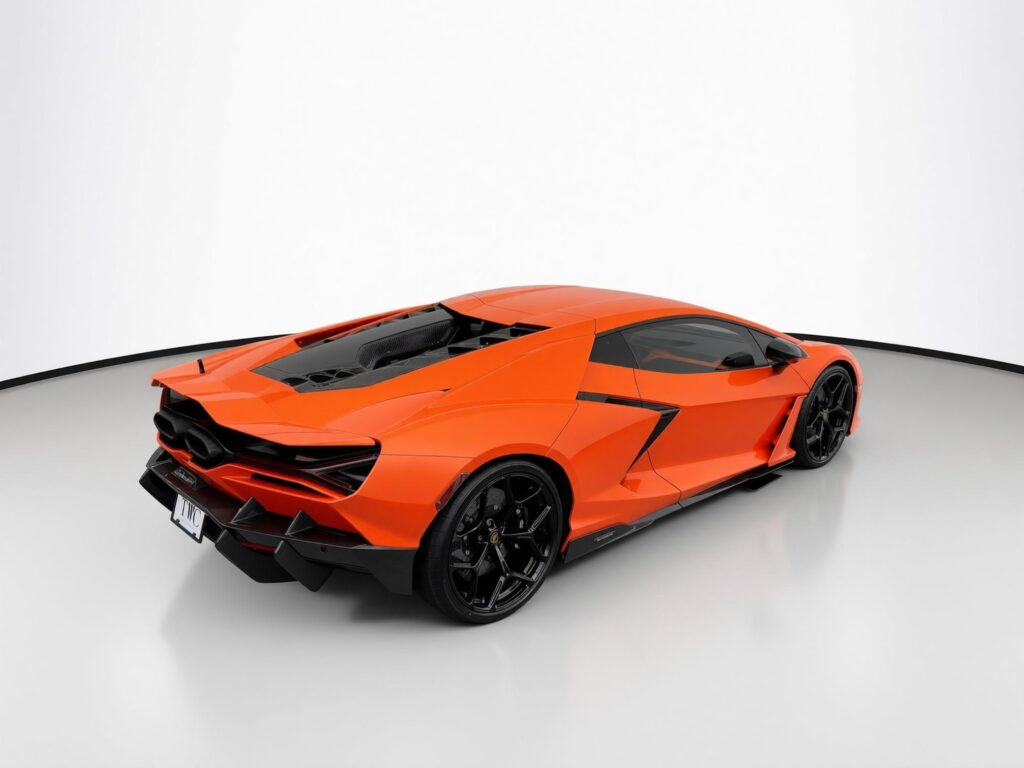
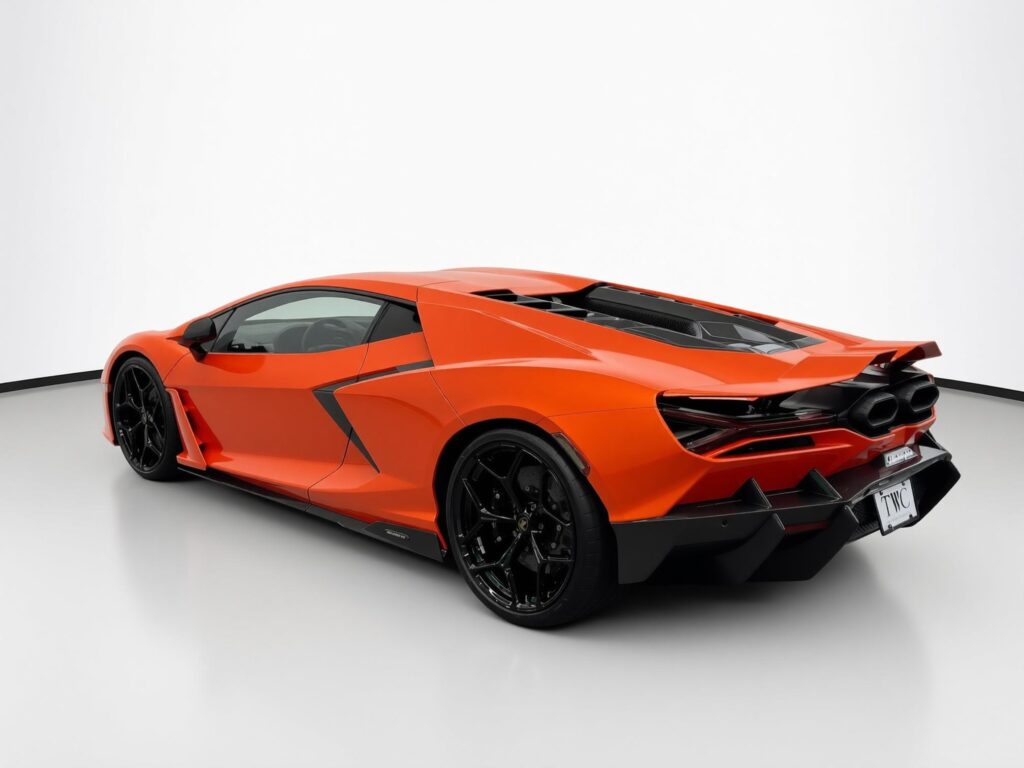
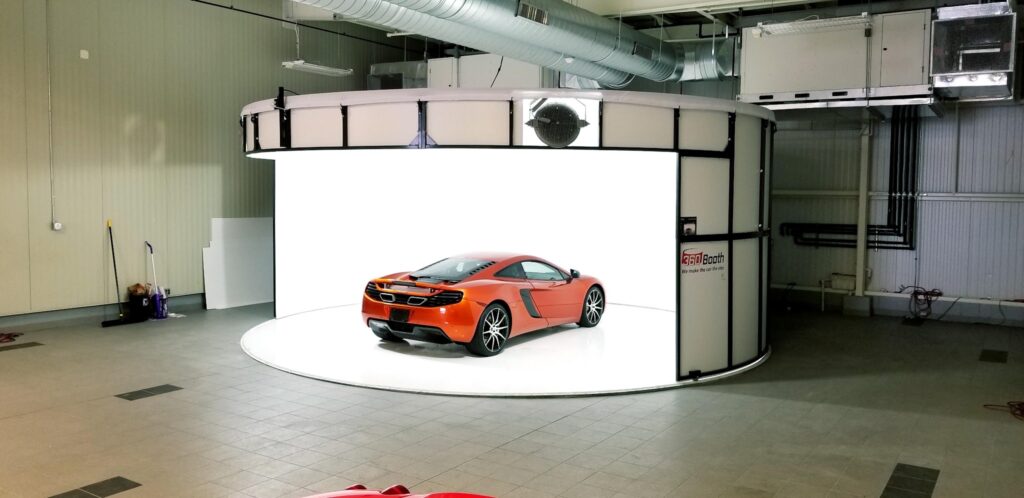
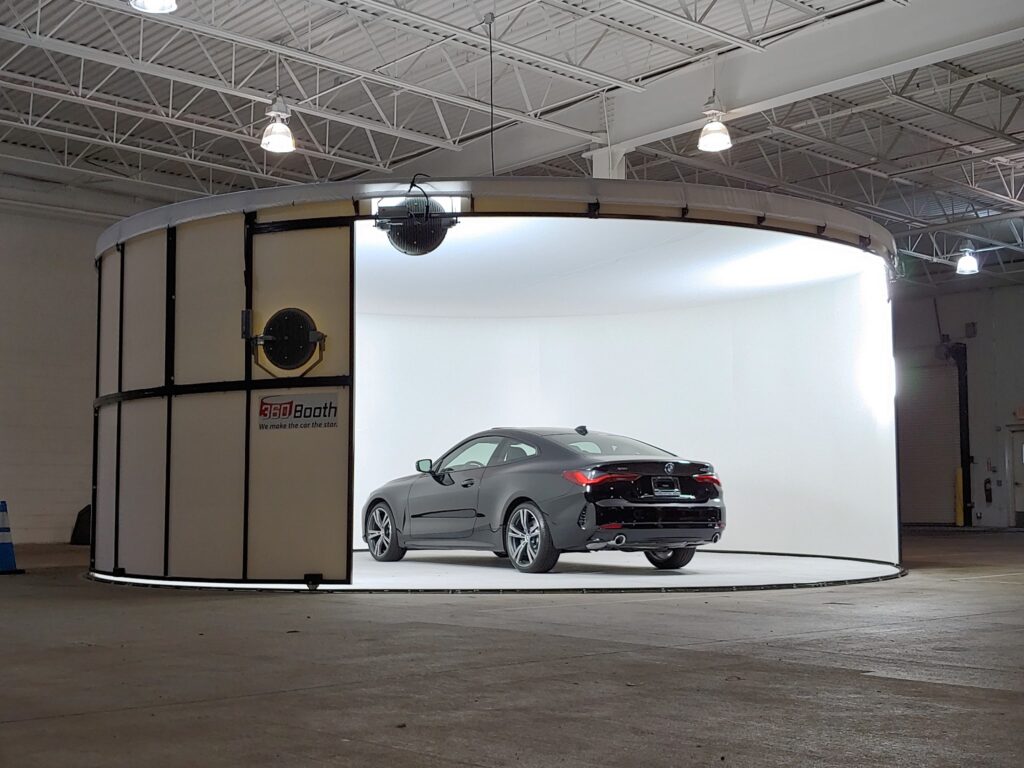
Direct answer: 360Booth uses matte white ePVC wall panels because the surfaces surrounding a vehicle affect its photographed appearance. Matte surfaces reduce sharp reflections from the studio walls, while the neutral white environment supports consistent lighting. Combined with four 5600K LED lighting heads and a diffused white ceiling, the walls help create a repeatable photography environment around the actual vehicle without digitally replacing its surroundings.
Your Vehicle Reflects Everything Around It
A dealership can purchase an expensive camera and still produce inconsistent vehicle photographs.
Why? Because the camera records the light coming from the vehicle, including reflections of its surroundings.
Look closely at a freshly detailed black SUV. You can often see ceiling fixtures, windows, equipment and nearby objects reflected across its painted surfaces.
Move the vehicle into another room, and those reflections change.
The vehicle hasn’t changed. Its surroundings have.
This is one reason the 360Booth vehicle photo studio was designed as a complete physical photography environment instead of simply a white background positioned behind a car.
The room is part of the photography equipment.
Why Matte White Walls Matter
360Booth uses matte white expanded PVC (ePVC) wall panels. The matte finish is intentional.
A glossy surface produces more concentrated, mirror-like reflections. A matte surface scatters reflected light across a wider range of directions.
That difference matters when photographing highly reflective automotive finishes. A shiny wall can introduce additional bright shapes and reflections into the vehicle’s body panels. A matte wall provides a more diffuse surrounding surface.
The purpose isn’t to eliminate every reflection. Reflections are valuable in vehicle photography. They help communicate the shape and curvature of body panels.
The objective is to make those reflections more manageable.
A controlled reflection helps reveal vehicle contours. An uncontrolled reflection can become a distraction or obscure visible details.
Why White Instead of Black or Colored Walls?
White surfaces reflect light broadly and provide a neutral surrounding environment. That supports the studio’s lighting design.
Colored walls can introduce unwanted color into reflections and nearby surfaces. Consider photographing a white vehicle beside a strongly colored wall. Some of that color can appear in the reflected light and the vehicle’s glossy surfaces.
Now photograph the same vehicle inside a neutral white environment. You’ve reduced one source of unwanted color variation.
Black surfaces have legitimate uses in specialized automotive photography because they can create contrast and define body lines. But a dealership needs a repeatable process for photographing different vehicles throughout the day.
360Booth uses a consistent white environment designed around that production requirement. The objective is reliable inventory photography, not rebuilding the lighting setup for every vehicle.
Why Does the Ceiling Use Diffusing Cloth?
The wall panels and ceiling serve complementary purposes.
The studio uses four LED lighting heads with a nominal 5600K color temperature. Above the vehicle is a white diffusing cloth ceiling made from durable polyester.
Rather than relying on harsh, exposed overhead fixtures, the cloth distributes the light more broadly across the photography environment. This helps reduce concentrated highlights and creates a more controlled lighting arrangement.
The ceiling diffuses the overhead illumination. The matte white walls provide a consistent surrounding environment.
Neither component operates independently of the vehicle, camera position or lighting arrangement. That’s why evaluating only the camera specifications tells an incomplete story, and why it belongs on the list of what a dealership should evaluate before buying a vehicle photo studio.
Why Does the 360Booth Structure Move Instead of the Vehicle?
This is another important part of reflection control.
A standard 360Booth does not use a motorized vehicle turntable. The vehicle remains stationary. The surrounding studio structure moves manually on a circular steel track using V-grooved wheels.
It also provides a practical photography advantage. The operator can reposition the surrounding studio structure and lighting environment when necessary. That can help manage reflections or improve lighting for interior photography.
The photographer is controlling the environment around the actual vehicle instead of digitally changing the vehicle after capture.
Do Matte Walls Automatically Reveal Every Scratch or Dent?
No. And this distinction is important for Authentic Capture™.
A controlled lighting environment can help photographers obtain clearer, more consistent views of vehicle surfaces. But detecting a scratch, dent or other imperfection depends on several factors:
The location and type of damage
Camera position
Viewing angle
Lighting direction
Image resolution
A matte white studio does not automatically make every surface defect visible. Nor should SHOOTit AI be described as perfectly identifying vehicle condition.
The purpose of the studio is to establish a more predictable environment for capturing evidence. Individual close-up photographs and physical inspection remain necessary when vehicle condition requires additional documentation.
Better photography conditions improve the opportunity to record visible evidence. They do not guarantee complete damage detection. That’s also why the original photographs should be preserved rather than replaced by edited versions.
Why the Physical Studio Still Matters in an AI Photography Workflow
AI can interpret images. It can evaluate certain capture characteristics. It can assist employees in following a required photography sequence.
But it cannot change the physical circumstances under which an original photograph was taken.
360Booth controls the physical surroundings. SHOOTit AI guides the evidence-capture process.
The first step in SHOOTit AI is capturing the VIN. The system uses VIN-decoder information to determine which requested equipment photographs are appropriate for that vehicle. If the employee attempts to skip a requested photograph of equipment identified as a standard feature, SHOOTit AI immediately warns the employee to check again.
The system then guides the dealership’s required 40+ image process. When an image is too dark, blurry or poorly centered, SHOOTit AI stops the workflow and immediately prompts the employee to reshoot before continuing. That’s quality control at the vehicle, not after it leaves.
The studio and camera address different problems. One provides the controlled environment. The other provides intelligent capture guidance. Together, they support 360Booth Authentic Capture™.
Does Every Dealership Need Matte White ePVC Walls?
Not every dealership has the space for a complete vehicle photo studio.
A properly planned DIY photography area may be appropriate in some buildings. SHOOTit AI can also guide vehicle photography outdoors.
However, a dealership should understand what it sacrifices when the physical environment becomes less controlled. A painted service bay with overhead fluorescent fixtures, windows and glossy surfaces is not automatically equivalent to a purpose-built studio. Its lighting and reflection characteristics must be evaluated. (Dealer groups mixing studios and DIY areas can see how in How Can a Dealership Group Standardize Vehicle Photography Across Multiple Locations?)
That is where access to more than 50 years of combined vehicle-photography expertise becomes valuable. Our experience includes lighting, color temperature, reflections, camera positioning, iPhone photography, studio installations and DIY photography environments.
The goal is to determine the best practical photography approach for the dealership’s actual building.
What About Maintaining the Wall Panels?
The walls are part of the studio’s photography environment and should be kept clean. Scuffs, dirt and other surface contamination can become visible in photographs or reflected surfaces.
Routine cleaning and inspection should therefore be part of the dealership’s studio upkeep. Damaged or heavily worn panels should be evaluated for replacement when necessary.
Cleaning methods should follow the material and installation guidance rather than relying on aggressive chemicals or abrasive equipment. A clean, consistent physical environment is part of maintaining consistent photographic results.
The Dealer Wake-Up Call
Dealerships spend thousands of dollars buying cameras, software and image-processing services. Then they photograph vehicles in buildings filled with uncontrolled reflections. And wonder why the pictures aren’t consistent.
Before asking AI to improve your vehicle photographs, ask whether you’ve given the camera a proper environment to photograph the vehicle in the first place.
That’s where Authentic Capture™ begins.
FAQ
What material are 360Booth walls made from?
Standard 360Booth wall panels are made from matte white expanded PVC, commonly abbreviated ePVC.
Why not use glossy white wall panels?
Glossy walls can produce stronger, more concentrated reflections. Matte panels provide a more diffuse reflective environment around the vehicle.
Do matte white walls eliminate vehicle reflections?
No. They help control the surrounding reflections. Vehicle paint and glass remain reflective, and camera position and lighting still affect the photograph.
Does 360Booth use natural daylight?
360Booth is designed around controlled studio illumination. Uncontrolled daylight entering through skylights or nearby windows should be evaluated during installation planning.
Does SHOOTit AI require matte white walls?
No. SHOOTit AI works in suitable photography environments independently of 360Booth. The studio provides additional control over physical lighting and surroundings.
Can a vehicle photo studio automatically detect damage?
Not simply because it has controlled lighting. Reliable vehicle condition imaging requires appropriate capture methods, image interpretation and, where necessary, physical verification.
Yes. A dealership should treat its vehicle-photography iPhone as production equipment rather than depend on an employee’s personal device. SHOOTit AI runs on supported iPhone Pro Max models purchased by the dealership, so the camera, training, workflow and operating standard stay with the store even when staffing changes.
The camera should belong to the process
Dealerships would never build a service process around a technician bringing whatever diagnostic equipment happened to be in their pocket that morning.
Vehicle photography deserves the same discipline.
Once a phone is responsible for documenting dealership inventory, it isn’t just a phone. It’s a production camera. It:
A dealership-owned iPhone keeps the production tool where the production happens. The employee may change. The camera remains.
Which iPhones does SHOOTit AI support?
SHOOTit AI is built around supported Apple iPhone Pro Max devices. Current operating guidance supports iPhone 12 through iPhone 17 Pro Max models, with support for future devices evaluated as new generations are introduced.
The dealership purchases the phone, which also keeps the normal device warranty relationship with the store.
The objective isn’t to force dealers into complicated camera equipment. It’s the opposite. Use a modern smartphone employees already understand, then put an intelligent vehicle-photography workflow on it. As we’ve said before, more megapixels don’t fix a missing process.
SHOOTit AI is more than a camera app
The workflow begins with the vehicle VIN.
SHOOTit AI uses VIN-decoder information to understand the expected vehicle configuration and guide the requested equipment photographs. If an employee tries to skip a requested image and the decoder shows that feature should be standard equipment, SHOOTit AI immediately tells the user to check again.
The employee then continues through the dealership’s required 40+ image process. If a required photo is too dark, blurry or poorly centered, SHOOTit AI stops the workflow and requires a reshoot before continuing. That’s quality control at the vehicle, not after the fact.
The important point: these operating standards live in the dealership’s capture system, not just inside one photographer’s memory.
A dedicated phone makes employee backup easier
Photography should survive staffing changes.
A dealership can train another employee on the same device and the same guided process instead of asking that person to reproduce another photographer’s personal habits. Basic SHOOTit AI instruction takes about three minutes.
That doesn’t make someone a professional photographer in three minutes. It means the employee can understand the guided process quickly enough to start using the system. That distinction matters. The expertise is built into the environment and workflow, so you can stop hiring people just to take vehicle photos.
What if a dealership wants two cameras?
A second active phone requires an additional SHOOTit AI license. Treat that as a capacity decision.
A high-volume dealership may want multiple trained employees or simultaneous capture. Another store may be better served by one dedicated device and trained backup employees. The right answer depends on actual throughput and staffing.
The 360Booth vehicle photo studio controls the physical photography environment. SHOOTit AI controls the guided capture process. A dedicated, dealership-owned iPhone completes the system by giving the store a consistent camera platform.
That creates three layers of standardization:
The room: controlled lighting, background and reflections.
The camera: a supported, dealership-owned iPhone.
The process: SHOOTit AI’s guided, VIN-first capture workflow.
Authentic Capture™ depends on recording the actual vehicle consistently. That starts with the physical vehicle and a controlled environment. Then it requires a capture tool that stays part of the dealership’s process.
The VIN identifies the vehicle.
SHOOTit AI guides what should be photographed.
The iPhone records what is physically there.
Visible wear stays visible. Actual equipment stays actual equipment. And the dealership keeps a repeatable way to create that evidence even when employees change.
Dealer wake-up call
Your vehicle-photography camera shouldn’t belong to the employee. It should belong to the operation.
Buy the phone.
Own the workflow.
Train more than one person.
Keep the process in the dealership.
If one employee can take your entire photography operation home in their pocket, you never really owned the process.
FAQ
Can employees use their personal phones for SHOOTit AI?
The recommended operating model is a dealership-owned supported iPhone dedicated to the photography workflow.
Which phones are currently supported?
SHOOTit AI supports selected iPhone Pro Max generations, currently including iPhone 12 through iPhone 17 Pro Max under current product guidance.
Does a second phone require another SHOOTit AI license?
Yes. Two simultaneously active capture phones require separate licenses.
Can a replacement employee learn the process quickly?
Yes. The guided SHOOTit AI workflow can be introduced in roughly three minutes, although experience improves speed and familiarity.
Does the phone need internet access during capture?
No. SHOOTit AI capture can work offline. Connectivity is required later for upload and delivery.
“The time and effort you put into inspecting the booth, evaluating the workspace, and following up with a detailed report was way above and beyond what anyone could have expected.”
— 360Booth customer, October 2025
“It has significantly enhanced the quality of our photo inventory and website, and it has trained our eyes to better recognize angles and focus points for each shot.”
— SHOOTit AI customer, May 2025
“Of all the vendors I deal with you guys are always on the ball to get things corrected, I appreciate it.”
— Auto Exact customer, May 2025
“I can’t tell you how much we appreciate you going out of your way to be here in person to help us.”
— 360Booth customer, December 2024
“The booth looks great and the app works really well.”
— 360Booth and SHOOTit AI customer, March 2025
360Booth Vehicle Photo Studio Reviews
Installation and on-site service
“Thank you for your prompt help getting the booth reinstalled.”
— 360Booth customer, September 2026
“Thank you to all for the assistance in getting the booth fixed.”
— 360Booth customer, July 2026
“Thank you so much for coming out, greatly appreciated.”
— 360Booth customer, January 2026
“We put the booth back on track and is functioning perfect again.”
— 360Booth customer, March 2025
“Helpful with answers when asked questions and a pleasure to have on-site doing the install.”
— 360Booth customer, November 2024
Photo quality and daily use
“You guys are awesome, thank you!”
— 360Booth customer, July 2025
“You guys are the best.”
— 360Booth customer, May 2025
“We love using our 360booth.”
— 360Booth customer, May 2025
“FYI our pics look great, I know our group is super interested.”
— 360Booth customer, December 2024
“Booth is awesome by the way.”
— 360Booth customer, November 2024
Fast answers and follow-up
“Thanks again for your excellent customer service.”
— 360Booth customer, October 2026
“Thanks for all your help answering my questions.”
— 360Booth customer, June 2026
“Thank you so much for the quick response to my email!”
— 360Booth customer, May 2026
“Thank you so much for your quick response.”
— 360Booth customer, July 2025
“Thanks … for the great service.”
— 360Booth customer, July 2025
“Thank you for the quick response and follow up with this project.”
— 360Booth customer, April 2025
SHOOTit AI Smart Camera Reviews
Better photos on the website
“Excellent and very helpful to the SUV shopper.”
— SHOOTit AI customer, December 2025
“Everything looks great! Thanks for your help!”
— SHOOTit AI customer, March 2026
“That sounds perfect, thank you for your help in this matter.”
— SHOOTit AI customer, January 2026
“Looks great. Thanks for all the help. I appreciate it.”
— SHOOTit AI customer, January 2026
Quick fixes and uploads
“Awesome, we got it back up. Thank you so much!”
— SHOOTit AI customer, August 2026
“Really appreciate the quick assist on this matter.”
— SHOOTit AI customer, June 2026
“Refreshed again and all working now.”
— SHOOTit AI customer, February 2026
“All 14 have uploaded successfully. Thank you for the quick response!”
— SHOOTit AI customer, February 2026
“Everything working perfect now.”
— SHOOTit AI customer, October 2025
“Thank you, it’s working great now!”
— SHOOTit AI customer, September 2025
Auto Exact Data Team Reviews
Websites, banners and reprocessing
“Looks perfect on our website. Thanks again!”
— Auto Exact customer, November 2025
“All looks good! Thank you for your help!”
— Auto Exact customer, October 2025
“Fantastic! Thank you so much. You guys are too good.”
— Auto Exact customer, September 2025
“Thank you for reprocessing both vehicles, I appreciate your help.”
— Auto Exact customer, August 2025
“The banners look great, thanks again!”
— Auto Exact customer, March 2025
Responsive, patient support
“Many thanks for your help and checking back in.”
— Auto Exact customer, July 2026
“Thank you so much for the quick turnaround on this.”
— Auto Exact customer, May 2026
“Really appreciate you helping us find a workaround!”
— Auto Exact customer, April 2026
“Thanks for the great follow ups. You guys are amazing.”
— Auto Exact customer, December 2025
“Thank you so much again for your patience, I really appreciate you for helping me all the time.”
— Auto Exact customer, November 2025
“I just wanted to express my gratitude for all your assistance. It has been wonderful working with you.”
— Auto Exact customer, May 2025
“You guys are the best.”
— Auto Exact customer, April 2025
“Thank you for your quick response—as usual!”
— Auto Exact customer, April 2025
“Great, thanks so much for the quick help!”
— Auto Exact customer, February 2025
“I am so grateful for your speedy support! Absolute legend!”
— Auto Exact customer, January 2025
“Thank you for the fast response and I will take a look and get back to you if anything else needs to be done.”
— Auto Exact customer, November 2024
“Thank you for the quick response.”
— Auto Exact customer, October 2024
Customer Support Across the System
“Working as should now, thank you for all of your help sir. It’s greatly appreciated.”
— Customer support, March 2025
“Just tested it and is back working fine again. Thanks a lot, I appreciate your help.”
— Customer support, November 2024
Want to see what dealers are talking about? Visit our Customer Reviews page or reach out below.
Listen to what Alex Shikhmuradov had to say about his experience with 360Booth®: “At Porsche Redwood City, we believe that every luxury car deserves to be showcased in its best light. That’s why we’ve invested in 360Booth® , a game-changer for photographing our inventory. In just 5-7 minutes, we can take professional-grade photos including stunning…
Pull up your recon board. Find the column labeled Photos.
Inspection is there. Used car manager approval is there. Service, parts, body shop and detail are all there. Photos? They just… happen. Eventually. When the weather cooperates and the camera person is in.
Most recon boards skip the photo step
When Dustin Jones of Rapid Recon studied the reconditioning data of 66 dealerships for WardsAuto, he found that few of them had a Photos step in their workflow at all. He called it a missed opportunity for time-to-line improvement.
Here’s why that matters. A step with no column has no owner. No owner, no clock. No clock, and nobody notices the “ready” car with zero pictures online.
Cox Automotive’s Q3 2026 Manheim Used Vehicle Value Index report expects off-lease supply to climb from about 190,000 units a month in the first half of 2026 to about 220,000 in the second half. Lease check-ins at Manheim are up 21% from the same time last year, and they grew from Q2 to Q3 when that quarter normally brings a seasonal dip.
Cox’s read on Q4 is simple: more volume.
More units through recon means more cars that can stall in the one step nobody tracks. If photos already wait on the weather and one person’s schedule at today’s volume, they won’t keep up when the off-lease wave rolls in.
DEALER WAKE UP CALL
A car isn’t frontline-ready until a shopper can see it.
The fastest car to sell is the one that gets online first. Every day a finished car sits without photos is a day it can’t generate a lead, and with values softening this fall, that day costs more than it used to.
Put photos on the board
Give photos their own column. Between detail and sale-ready, where it belongs.
Give the step an owner. One accountable person per shift, not “whoever’s free.” Your process shouldn’t depend on one person either, so train a backup.
Give it a clock. Track time from detail-complete to photos-live, the same way you track every other step.
Make it boring. The same shots, the same order, the same result on every car.
Boring is the goal. A step only stays on schedule when nothing outside it can stop it.
How 360Booth and SHOOTit AI make the photo step boring
SHOOTit AI walks your team through the same 40+ shots on iPhone and stops dark, blurry or off-center frames for a reshoot before anyone leaves the car. That’s quality control at the vehicle, not after the listing goes live. Done once.
How many cars on your lot are “ready” but not photographed?
Sources: Cox Automotive, Q3 2026 Manheim Used Vehicle Value Index report (Oct. 7, 2026); Dustin Jones, “Getting More Out of Used-Car Reconditioning,” WardsAuto (Oct. 2021).
Direct Answer: After you submit a 360Booth contact form, our team reviews your vehicle photography needs, discusses studio options and pricing, and evaluates your proposed space using your photos and measurements. As the project moves forward, we coordinate a walk-through visit, document the site findings, prepare your layout and quote, confirm installation readiness, schedule shipping and installation, and arrange training and SHOOTit AI setup so your team can start photographing vehicles.
The 13 Steps at a Glance
Your inquiry is received.
Your project information is organized.
We discuss your needs.
You receive product information and pricing.
You provide photos and measurements.
A walk-through visit is coordinated.
Your location and studio configuration are evaluated.
The site findings are documented.
Your layout and quote are prepared.
Your order and payment arrangements are confirmed.
Your installation readiness is checked.
Shipping and installation are coordinated.
Your studio is installed and your team gets started.
Here’s what each step looks like, from your first inquiry to photographing vehicles.
Phase 1: Understanding Your Dealership
Step 1: What happens when my inquiry is received?
Your contact form starts the conversation about a 360Booth vehicle photo studio for your dealership or automotive business.
Most dealers reach out because their current photography process is slow, inconsistent or dependent on the weather. If you’re still deciding whether a studio makes sense, start with why it’s so helpful to have a 360Booth vehicle photo studio.
Step 2: How is my project information organized?
Your contact details, dealership information and project notes are kept together so the team can coordinate follow-up without asking you the same questions twice.
That same single-point coordination continues after installation. See how the studio, the camera, the data team and customer support work as one connected vehicle photography system.
Step 3: What do we discuss about my needs?
We review your current photography process, vehicle volume, available space and timing to understand what your operation requires.
Measurements, photos and preparation requirements become the working reference for your project. Any items that need attention are identified before installation, not on installation day.
Once you accept the quote, invoicing and payment arrangements are coordinated according to your order terms. Orders are placed through the 360Booth order form.
Step 13: What happens when my studio is installed?
The installation team assembles the studio. Training, SHOOTit AI setup and data-feed coordination are arranged as needed to get your vehicle photography operation running.
From there, SHOOTit AI guides your team through each required image on an iPhone and prompts a reshoot when an image is too dark, blurry or poorly centered. Learn more:
Contact 360Booth to request product information or book a walk-through visit. The sooner we see your space, the sooner we can identify what your site needs before installation day.
FAQ
What happens after I submit a 360Booth contact form?
The 360Booth team reviews your vehicle photography needs, discusses studio options and pricing, and evaluates your proposed space. As the project moves forward, the team coordinates a walk-through visit, layout and quote, installation readiness, shipping, installation and training.
What information should I have ready for the first conversation?
It helps to know your current photography process, monthly vehicle volume, the space you’re considering and your preferred timing.
Do I need to send photos and measurements of my space?
Yes. Photos, basic dimensions and any available floor plans help the team evaluate the proposed location and identify questions before the walk-through visit.
What does the 360Booth site evaluation check?
The evaluation reviews studio placement, vehicle access, floor conditions, overhead obstructions and electrical requirements to determine the appropriate studio configuration.
What electrical service does a 360Booth studio need?
A standard U.S. installation needs a dedicated 110V, 20A circuit and a one-hour timer switch, prepared by the dealership’s local electrician before installation day. See the electrical requirements.
What must be ready before the studio is delivered?
The installation area must be clear, electrical work must be complete, and delivery access and unloading arrangements must be in place.
Is training included after installation?
Training, SHOOTit AI setup and data-feed coordination are arranged as needed so your team can start photographing vehicles.