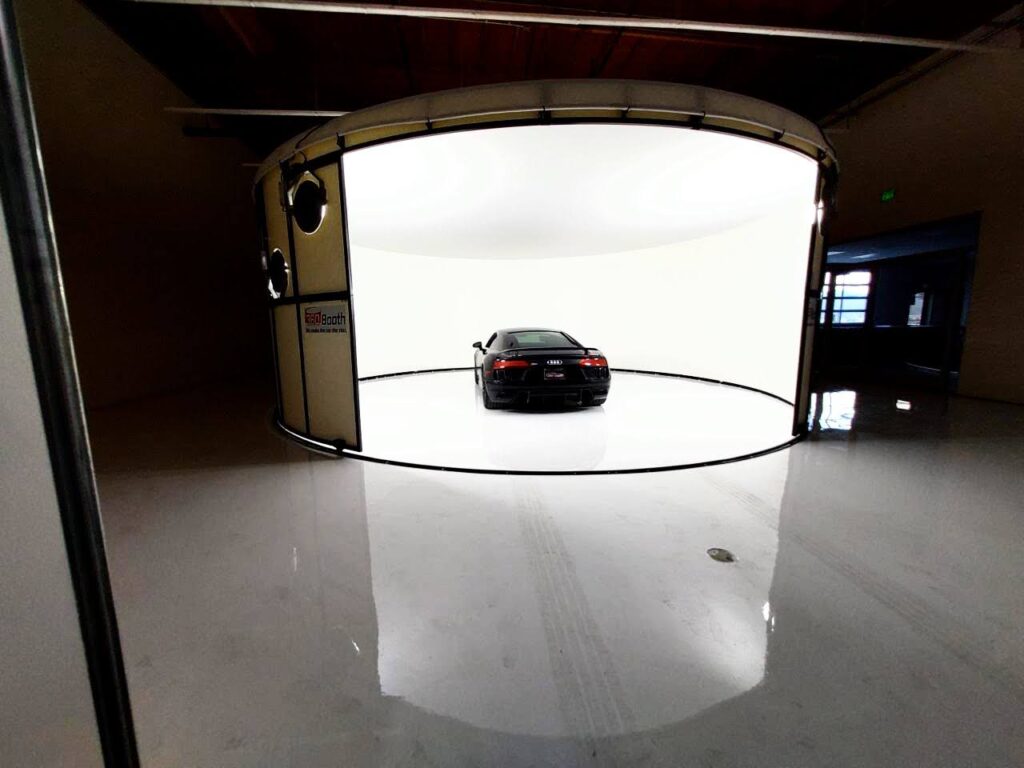
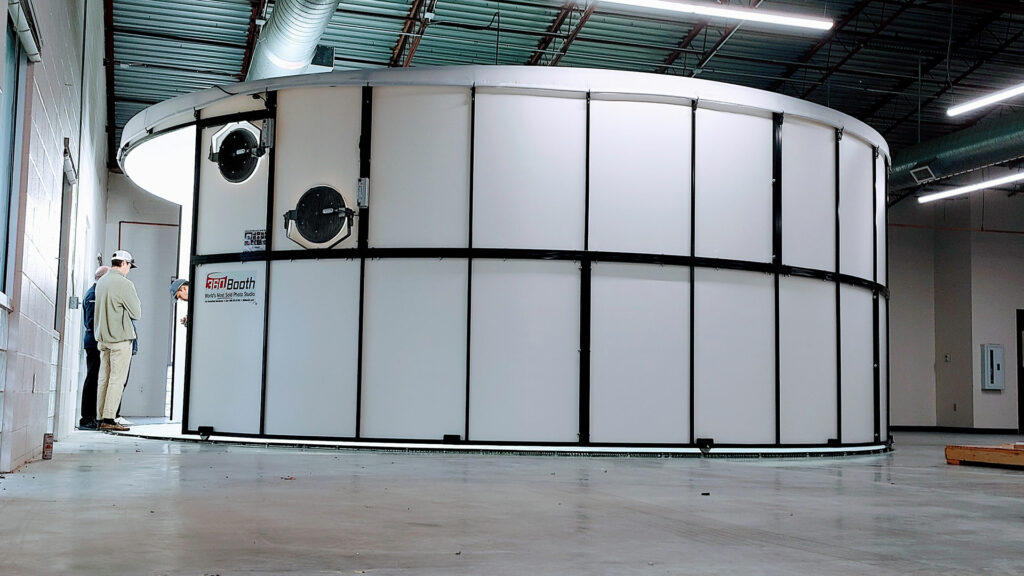
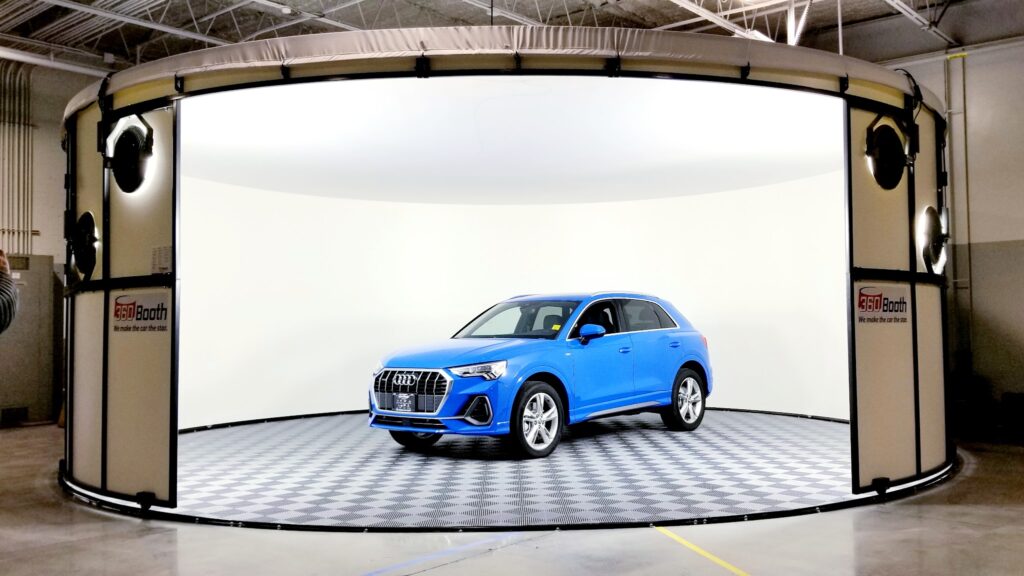
Your question is a great one, and I’d love to be involved in any new and fresh ideas in and outside of the auto industry as far as building bigger or smaller studios.
Your question is, “Jay, I’ve seen your spec. You have a 24, a 26, a 28. I heard you built a 30, 35,…” and you’re 100% correct. I’ve even built 31’s. I’ve built them smaller–24, 17–for industries out of the car business. Motorcycle, for instance.
To answer your question, absolutely. I would love to be involved in the next latest and greatest ideas as far as photo studios, whether it be in or out of the auto industry.
FAQ
Can 360Booth® build studios larger or smaller than standard?
Yes. Beyond the standard 24, 26 and 28-foot sizes, 360Booth has built 30, 31 and 35-foot studios and smaller ones, such as a 17-foot studio.
Can a 360Booth be used outside the car business?
Yes. 360Booth has built studios for other industries, such as motorcycles.
Direct answer: Yes, a 360Booth vehicle photo studio can potentially be installed over concrete with radiant in-floor heating, but the heating system must be evaluated before anyone drills or anchors the studio track. Heating tubes, electrical heating elements and other embedded systems need to be located and documented first. Professional concrete scanning, careful installation planning and the right fastening method all reduce the risk of damaging the floor.
The Floor Looks Empty. What’s Underneath It?
A dealership finds the ideal spot for a 360Booth vehicle photo studio.
The room is big enough. The ceiling is high enough. The vehicle entrance works. The lighting can be controlled.
Everything looks ready.
Then someone mentions the building has radiant heating embedded in the concrete floor.
That changes the conversation. The question is no longer whether the studio fits. It’s what might be damaged when the track is secured.
Before you install equipment on a concrete floor, understand what’s inside that floor.
How Is the 360Booth Track Installed?
A standard 360Booth does not use a motorized vehicle turntable. The vehicle stays stationary while the studio structure moves around it by hand.
The structure rolls on V-grooved wheels along a circular track made of black powder-coated steel. That track sits on top of the existing concrete, so the dealership doesn’t need to build a recessed turntable pit.
During installation, the track is positioned, leveled with shims and secured to the floor with concrete anchors.
That’s straightforward when the concrete is suitable. Concrete with concealed heating needs more investigation first.
Why Does Radiant Floor Heating Matter?
Radiant floor heating uses either water-filled tubing or electrical heating elements installed in or beneath the concrete. Once the floor is poured, you can’t see them. A contractor looking at the finished surface can’t reliably tell where they run.
Drilling into a heating tube can cause a leak.
Damaging an electrical heating element can create an electrical hazard and knock out the heating system.
Repairing either one may mean opening up the finished floor.
That’s why in-floor heating has to be identified before installation starts. The same goes for other concealed components, such as electrical conduit, reinforcing steel and post-tensioning tendons. A floor that looks suitable isn’t proof that it is.
What Should Be Done Before Installation?
1. Identify the existing heating system
Confirm whether the proposed studio area has radiant heating. Building drawings, renovation records and the facility manager are good places to start. The installation team needs a general picture of the system before planning where anchors go.
If the building has been renovated, the original drawings may no longer match what’s in the floor. Documentation is a starting point, not proof that every concealed component has been found.
2. Arrange professional concrete scanning
A qualified concrete-scanning provider should evaluate the area where the track will be anchored. Ground-penetrating radar (GPR) is a common method for locating radiant heating tubes, conduit and other objects inside concrete. Scanning providers typically mark what they find directly on the floor so the installer can plan around it.
3. Document where the embedded components are
The scan results should show the area evaluated and mark every detected component. Keep that documentation and share it with the 360Booth installation team before anchor locations are finalized.
Marking the floor doesn’t help if the results never reach the people doing the work. The goal is for the person planning the installation and the person drilling to have the same information.
4. Agree on an approved installation plan
The installation team evaluates the actual floor conditions and decides whether a suitable anchoring arrangement is possible. Fastener type, placement and penetration depth are project-specific. They depend on the slab construction and where the embedded systems are.
Where structural conditions call for it, the building’s engineer or another qualified construction professional should review the plan.
If the heating system can’t be adequately located, installation doesn’t proceed on the assumption that drilling will be safe.
Does Concrete Scanning Guarantee Nothing Will Be Damaged?
No. Scanning is an important way to reduce risk, but it can’t promise that every concealed object will be found.
Results depend on the concrete mix, reinforcement, how deep the targets are, the tubing material, the scanning equipment and the operator’s experience. Closely spaced or deeply embedded objects can be hard to pick up.
A qualified scanning professional should note any areas of uncertainty. When a critical component can’t be located with confidence, drilling stops until the question is resolved.
A scan is evidence for planning. It isn’t permission to guess.
Does a Heated Floor Change the Photography Process?
No. Once the studio is installed, daily photography works the same as in any other building.
360Booth provides the controlled environment: the vehicle stays put while the studio moves, lit by four 5600K LED lighting heads under a diffusing white ceiling. SHOOTit AI guides the capture, starting from the VIN, walking the employee through the dealership’s 40+ image sequence and stopping for a reshoot when an image is too dark, blurry or off-center.
The heating in the slab is an installation consideration. It doesn’t add a single step to daily photography.
Why Site Planning Matters
Dealerships usually judge a potential studio location by space. That’s necessary, but it’s not the whole picture.
A standard 24-, 26- or 28-foot 360Booth needs a minimum clear room of 30 feet long (in the vehicle-entry direction) by 30 feet wide by 11 feet high. The studio itself stands 10 feet tall, with standard entrance openings of 14, 16 and 18 feet respectively.
A vehicle photo studio should be simple to operate. That doesn’t mean its installation should be handled casually.
The last thing a dealership needs is a damaged heating system because nobody asked what was under the concrete.
We’ve spent more than a decade installing vehicle photo studios in all kinds of dealership buildings. Every building is different. Our job is to find those differences before they become installation problems. Here’s how that process starts.
The smartest installation begins with understanding the building, not discovering what’s under the floor with a drill. That’s how you protect the facility and give 360Booth Authentic Capture™ a long-term home.
FAQ
Can 360Booth be installed over radiant floor heating?
Potentially, yes. The heating system must be located and evaluated before an approved installation and anchoring plan is set.
Does the 360Booth track sit inside the concrete?
No. The standard track sits on top of the existing concrete. It doesn’t need a recessed turntable pit.
Does 360Booth use concrete anchors?
Yes. The standard installation anchors the track to the floor. The final fastening arrangement has to suit the specific floor.
Can ground-penetrating radar locate radiant heating pipes?
It can help locate embedded tubing and other concealed components. How well it works depends on the slab construction and scanning conditions.
Does scanning guarantee the heating system won't be damaged?
No. Scanning reduces uncertainty but can’t guarantee every component is found. Unresolved areas need more evaluation before anyone drills.
Should the dealership arrange scanning before installers arrive?
Yes. When in-floor heating or other embedded systems are known or suspected, scanning should be coordinated during installation planning.
Does radiant floor heating interfere with SHOOTit AI?
No. Floor heating is a building infrastructure issue. SHOOTit AI’s guided camera workflow is completely separate from how the track is anchored.
You’re looking at photo studios, and your question is what type of flooring? It’s entirely up to you. I love the epoxy, but know going in that you are going to need maintenance. With new epoxy, you’re going to mop and sweep every time a car pulls in.
We recommend Swisstrax. The reason we recommend Swisstrax is that it’s see-through! Look at the pearlescence in it and the color silver. It reflects the right color temperature back into the room so you don’t have colors.
Let me show you another demonstration.
Okay, here’s my demonstration. (I feel like one of those TV commercials.) Here’s water. Find the water on Swisstrax. Now, over here on epoxy and concrete, now look at the water. Watch. Even if I mop here, it doesn’t do anything. If I mop over on the epoxy or concrete, it takes time to dry.
Look at the difference. You don’t see it over here, but you see the water there. That’s low maintenance. That’s why we recommend Swisstrax.
FAQ
What kind of floor should I use in my 360Booth®?
It’s up to you. Epoxy looks great but needs mopping and sweeping often. 360Booth recommends Swisstrax for low maintenance.
Why does 360Booth recommend Swisstrax?
Its open design lets water and debris fall through so it stays clean-looking, and its silver tone reflects neutral light back into the room instead of adding color.
How tall of a vehicle will fit in the 360Booth®? The structure is 10 feet. The opening, or what we call the overhang, is at nine feet. With almost 800 studios in the ground, six years, there has not been a dealership that couldn’t fit a vehicle in the studio. I’m 6’5”. My reach is 8’3”, and that first bar is nine feet.
There are a few vehicles–your sprinter vans, vehicles like that–that will not fit.
To answer your question, the studio is ten feet; the overhang is nine. How big of a vehicle can you put in there? Anything under nine feet.
FAQ
How tall a vehicle fits in a 360Booth®?
Anything under about nine feet. The structure is ten feet tall and the opening (overhang) is nine feet.
Which vehicles won't fit?
A few very tall vehicles, such as high-roof Sprinter-style vans, won’t fit through the nine-foot opening.
This is a great question. You’ve received our literature. You’ve seen one, two, or three of our 800 studios, and your question is, “Jay, your spec was very helpful. I don’t have the space in my dealership, but I have a parking garage.”
I think we have probably 30 studios in parking garages throughout Florida, California, and other areas. The only reason that parking garages are a challenge is that the concrete slopes for rain, so it’s difficult to find a fairly level space. However, I have had dealers go the extra mile to skim-coat a space level. We’ve built decks in them. Dealers have built decks out of pressure-treated wood to support the studio on a level playing ground.
So, your question is that you can’t find space inside your dealership. Did you ask me to visit? Let me see if I can find a space.
Let’s say we visited, and all you had was that parking garage. Yes, we have them in parking garages. I think it’s a great fit. We have to look for the right spot. It’s not an issue. Let me visit. Give me a shot.
FAQ
Can a 360Booth® be installed in a parking garage?
Yes. 360Booth has studios in parking garages in Florida, California and elsewhere.
What's the challenge with parking garages?
Garage concrete slopes for drainage, so it can be hard to find a level spot. Dealers have solved this by skim-coating an area level or building a level deck.
360Booth® studio’s track rides on top of the existing concrete. We do not need any concrete work, any electrical work, no permitting, nothing. It simply is laser-leveled with shims on your existing concrete. Yes, trucks–everything–rides over it. It’s solid steel and black-powder coated. It is strong. I’m going to give you a little test, and I’m also going to walk you through what the track looks like.
All right, there’s an extreme close up and view of our track. It is solid steel. It’s about three inches thick, about a half inch tall. We secure the track with these amazing hilti screws. We go about three inches into the ground. The worst thing we’ve seen is some powder coating breaking off.
Here’s a hammer and some great beatings to it, and it’s strong and fearless.
FAQ
Is the 360Booth® track set into the ground?
No. It sits on top of your existing concrete and is laser-leveled with shims, so no concrete work, electrical work or permits are needed.
What is the track made of?
Solid, black powder-coated steel, secured with concrete screws that go about three inches into the floor. Vehicles, including trucks, drive over it.
Jay, I don’t have the space. I looked at your spec. I don’t have the space anywhere in my dealership. What can you do? Can I put it in an event tent or an outdoor tent?
Once again, if you haven’t heard, I visit everyone’s space. Let me visit your space. Let me walk your dealership. Let me make some recommendations before you go to tents or outdoor buildings.
But, to answer your question, “can you put it in a tent?” We have them in tents, but they are ruggedized. If you’re up north, a tent–no way–is going to support the weight of six, eight, or nine inches of snow. If you’re in Florida, Louisiana, the coast of Texas, I wouldn’t put a tent where a hurricane wind at 50 mph or higher would blow it down.
To answer your question, “Can you put it in a tent?” Yes. Let me walk your space first, and then let me give the specs to your tent company.
FAQ
Can I put a 360Booth® in an outdoor tent?
Yes, but the tent must be ruggedized. 360Booth will visit first to look for indoor options, then give the specs to your tent company.
When is a tent a bad idea?
Where heavy snow or hurricane-force winds are likely, since a standard tent may not withstand them.
Probably the coolest thing over the past six years is that I have reached only the one-percenters of the car industry who really are wanting to take their business to the next level with better photos. It’s so much fun.
The question is, “I’ve looked at your specs, Jay, and I don’t have the 11 feet of minimum clearance. Your studio is at 10 feet. I only have 10 feet of clearance. Can you help? What can you do?”
Great news. Right now, we do not charge to customize your studio at all. We have made them smaller; we’ve made them bigger, and we’ve definitely made them shorter at no cost to you.
So, thank you for doing the due diligence of measuring your space. I love it when you guys send me the photos with the dimensions of length, width, and height of it. I want to get a better idea of what I’m looking into when I visit.
But, to answer your question, if you don’t have the height, when I visit, I properly measure for placement, and we will chop your studio down. It will not affect the photos, and I will not charge you for that.
FAQ
What if my ceiling is too low for a 360Booth®?
360Booth can cut the studio down to fit your space after measuring it, and says this doesn’t affect the photos.
Does it cost extra to shorten the studio?
At the time of this post, 360Booth said it wasn’t charging for size customization. Confirm current pricing with 360Booth.
What should I send before the visit?
Photos of the space with its length, width and height help 360Booth plan the visit.
Do your lights in your existing space, or around the space, or in your building need to be turned off during shooting?
There are a couple of ways to handle that. First of all, I evaluate your space. I will make recommendations on what lights have to be turned off or removed. Usually, I focus strictly on above the cloth top. In some cases, you’ll only see that in other people’s booths or studios because they don’t have a cloth top to shield the lights reflecting on the top of the car.
So, to answer your questions, you don’t have to shut them all off. I don’t want you to do that. It’s a hazard, for one, but the ones directly above the cylinder of the studio, yes. We would like those turned off. They’re not the right color temperature, and they will cause issues inside the studio.
FAQ
Do I need to turn off other lights when shooting in a 360Booth®?
Not all of them. Only the lights directly above the studio should be turned off, because their color temperature can cause issues inside.
How does 360Booth prevent overhead light reflections on the car?
The studio’s cloth top shields the vehicle from overhead lights reflecting on its roof.
What happens if the sun enters the studio from an open window, skylight, or garage door?
Hopefully, it doesn’t last long. It’s not going to hurt the studio at all. Worst-case scenario is if the sun is bright enough, which, it’d be hard to be brighter than our lights in the studio, but if it is, and lower, it will penetrate the plastic, and it will cast a shadow of the steel structure in the background. We’ve never had that complaint, but visually, if the sun hits the studio directly from an open window, a door, or a skylight, it will give spots on your car, but it will also penetrate the plastic and show the outline of the steel frame.
FAQ
Will direct sunlight damage a 360Booth®?
No. Sunlight from a window, skylight or open door won’t hurt the studio.
How can direct sun affect photos?
If the sun is strong and low enough, it can shine through the plastic walls, showing the outline of the steel frame and causing bright spots on the car.